
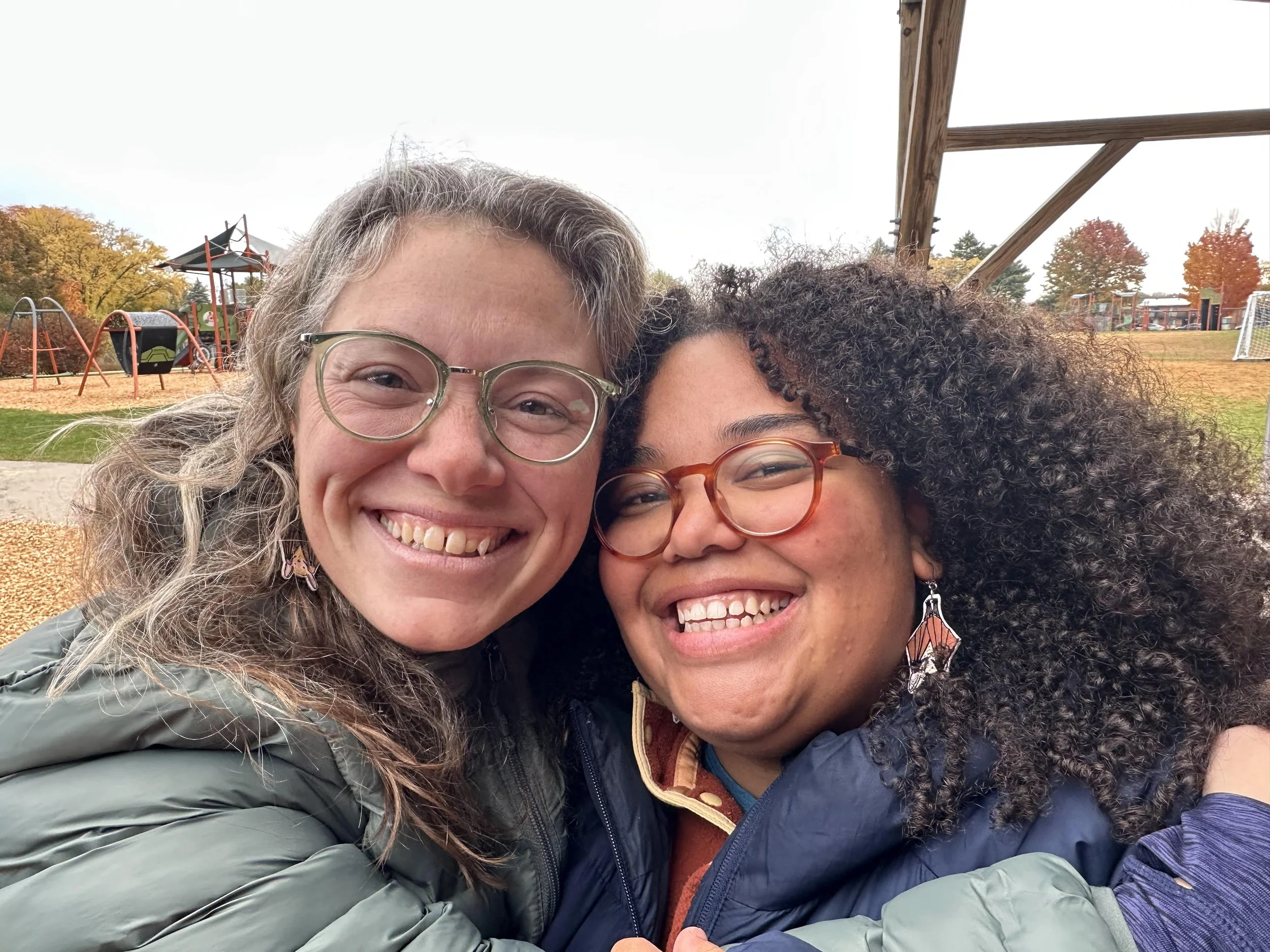
Carolyn and Mickenzee out teaching (photo by Lincoln teacher)
In this episode, we answer questions like “How did Bald Eagles get their name?” and debunk some common animal fun facts with our guest Carolyn Byers, Education Director here at Southern Wisconsin Bird Alliance.
Subscribe to QuACK on Spotify, iHeart Radio, Apple Podcasts, or your favorite podcast app!
Transcription
Hey, and welcome to Questions Asked by Curious Kids, or QuACK, a podcast made by Southern Wisconsin Bird Alliance. This is a podcast where we gather questions about nature from kids to be answered with a local expert. My name is Mickenzee, I'm an educator and I'll be the host for this series. In this episode I'll be talking with Carolyn Byers, our education director, about busting some common misconceptions, or animal facts that kind of exaggerate a little bit.
-----
Mickenzee: All right, let's jump in with Carolyn. Okay, so today we're going to be addressing some common misconceptions or maybe animal facts that people often misremember or just totally aren't true.
Carolyn: Like myth busting?
Mickenzee: Yeah, totally.
Carolyn: Nice!
Mickenzee: We're going to be addressing some flimflam. Okay, we have a lot of worm related questions. It seems to be a phenomenon with the kids we work with, a lot of worm stuff comes up. So the first thing I wanted to ask about is if you break a worm in half, a lot of people say both halves live and it's like you have two worms now. Is that true, Carolyn?
Carolyn: I have heard that growing up, I sent a lot of good thoughts to a lot of worms.
It is not true.
Mickenzee: No!
Carolyn: I know, I know. Worms, they have organs inside their bodies, they’re not quite like ours but they're, you know, they've got organs, they all have a job. And depending on where you break the worm, it's possible one half could live. Usually it's the head half, right? They might grow a new tail, but if you don't get enough of those organs in the head half or, you know something happens, often both halves die.
Mickenzee: Poor worms.
Carolyn: I know, so don't go breaking worms in half trying to make more.
Mickenzee: And then we get this a lot where we'll be talking about an animal, what it eats. And I feel like with any animal we say, a lot of the guesses are it eats worms. So I know that there’s quite a few animals that eat worms, I know not all animals eat worms. What are the animals that do eat worms?
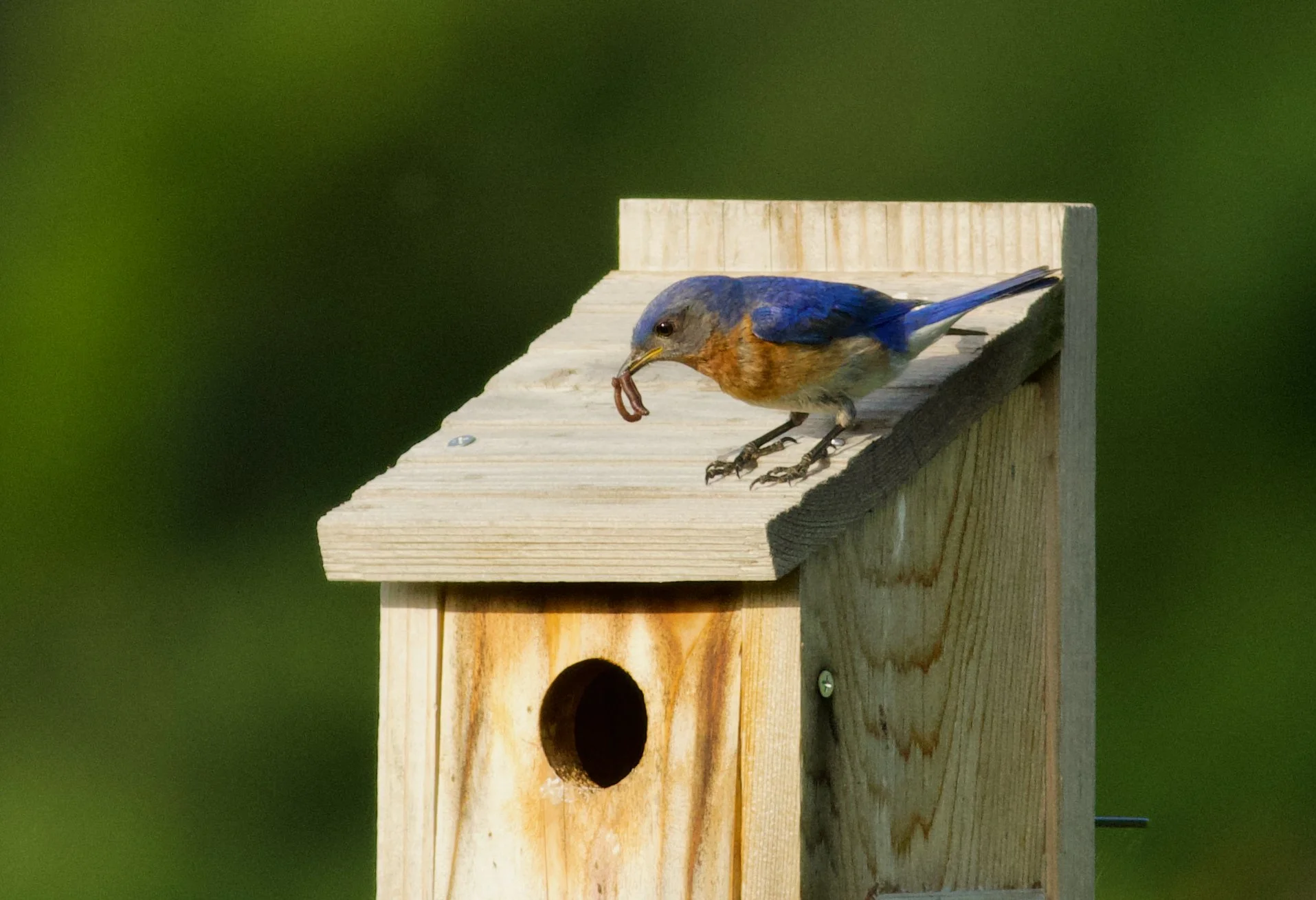
Eastern Bluebird with a tasty earthworm snack (photo by Arlene Koziol).
Carolyn: Yeah. So I'm not a worm expert, but I do know there's a lot of creatures that, you know, they might have a long, slender body. They might be that peachy pinky color, right? We might say they're worms, but they might not actually be a worm like how a scientist thinks of a worm. So I think that that's one interesting layer to it. Another thing is, if you're thinking about, like, earthworms that you might go fishing with, a lot of those are not native to, to most parts of the U.S. So they came from Europe. And so our animals didn't really evolve to eat them, right?
Mickenzee: Right.
They're coming from a new place. But if we are thinking about earthworms like you're fishing with, there are totally some birds that do eat them. Robins for sure love a worm. Slurping them up, they're so good. There's a bird called a Woodcock and they love eating worms. They have a really long beak, and they have these cool eyes that are very far on the back of their head, so they can put their whole beak into the dirt and feel around for worms, but they can still look for predators with their eyeballs. So they eat worms. There's other birds, like the Worm-eating Warbler, and they eat different kinds of things that are not technically worms.
Mickenzee: That's so funny.
Carolyn: It's a little tricky for sure. So we do have some birds that like to eat worms.
Mickenzee: Totally. Speaking of those birds, Robins, I've always heard this growing up that when you see a Robin, that means spring is here, they're a sign of spring. But I have a hunch that that might not be all the way true.
Carolyn: It's not all the way true. Or at least depending on where you live it's not all the way true. So in Wisconsin, a long time ago, like 100 years ago, Robins mostly migrated. So they would be here during the spring and summer, and they would leave during the fall and definitely be gone during the winter. Now as climate is shifting, weather patterns are changing, Robins, they stay around in Wisconsin all year. And maybe some migrate, maybe they're not the same robins. But we as humans just looking around checking if we can see a robin today, we'll probably see Robins throughout the entire winter. So just seeing a Robin doesn't mean it's spring. If you see a large number of Robins, that could be Robins migrating up through Wisconsin heading further north. That's definitely a sign of spring.
Mickenzee: Yeah!
Carolyn: And you can also listen for Robins singing songs like when they're trying to set up their territory or find a mate. They'll sing this song, okay, I'm not going to sound like a Robin, but to me, in my brain it sounds like “chirrup chirro chiree chirreye”.
Mickenzee: Yeah!
Carolyn: And when you hear that, it does mean we're getting close to spring. It's time.
Mickenzee: Yay! I know, this cold weather, I'm getting excited to look for those signs of spring. Oh speaking of spring, along with spring comes baby birds. And oftentimes we tell people, or there's adults telling us, you know, leave baby animals alone, leave nests alone. And if you touch that baby the mom's going to smell you and abandon their nest or abandon their baby.
Carolyn: Okay. So this one is not true, but you still shouldn't touch baby birds, okay, or any baby animals, really. So most birds can't smell or they don't rely on their sense of smell very much, okay? So that's fact one. Fact two is that mama birds take very good care of their babies. They invested a lot of energy and a lot of time in making the eggs and keeping them warm and, you know, raising their babies. They're not going to abandon them just because they smell a little different, okay? Even if, you know, they could smell. So they're not worried about that. But the problem is there's a lot of animals that do rely really heavily on smell that also want to eat baby birds. So if humans touch a baby bird or the nest or, you know, the vegetation and the plants around the nest and then you know their scent is on those things, human scent is on those things, animals like raccoons or skunks or foxes or house cats that get let outside, they will be able to find the nest a lot easier.
Mickenzee: Oh, it's like we're making a trail leading them right to it.
Carolyn: Definitely. So the only reason I would touch a baby bird is if I found a nest that fell or a baby that fell out of the nest, and then I would put them back in the nest and try not to touch anything, anything around the nest, try not to put my scent anywhere. And that would be the only reason I would touch a baby bird, but you should get a grown-up’s help for that, for sure.
Mickenzee: Definitely, definitely. All right, on the same line about birds and we also were talking a little bit about tricky names. So bald eagles are an iconic bird. They've got that striking big yellow beak, their brown bodies and their white head. They're called a bald eagle though, and a lot of people are wondering why are they called bald? It's not like they don't have any feathers on their head.
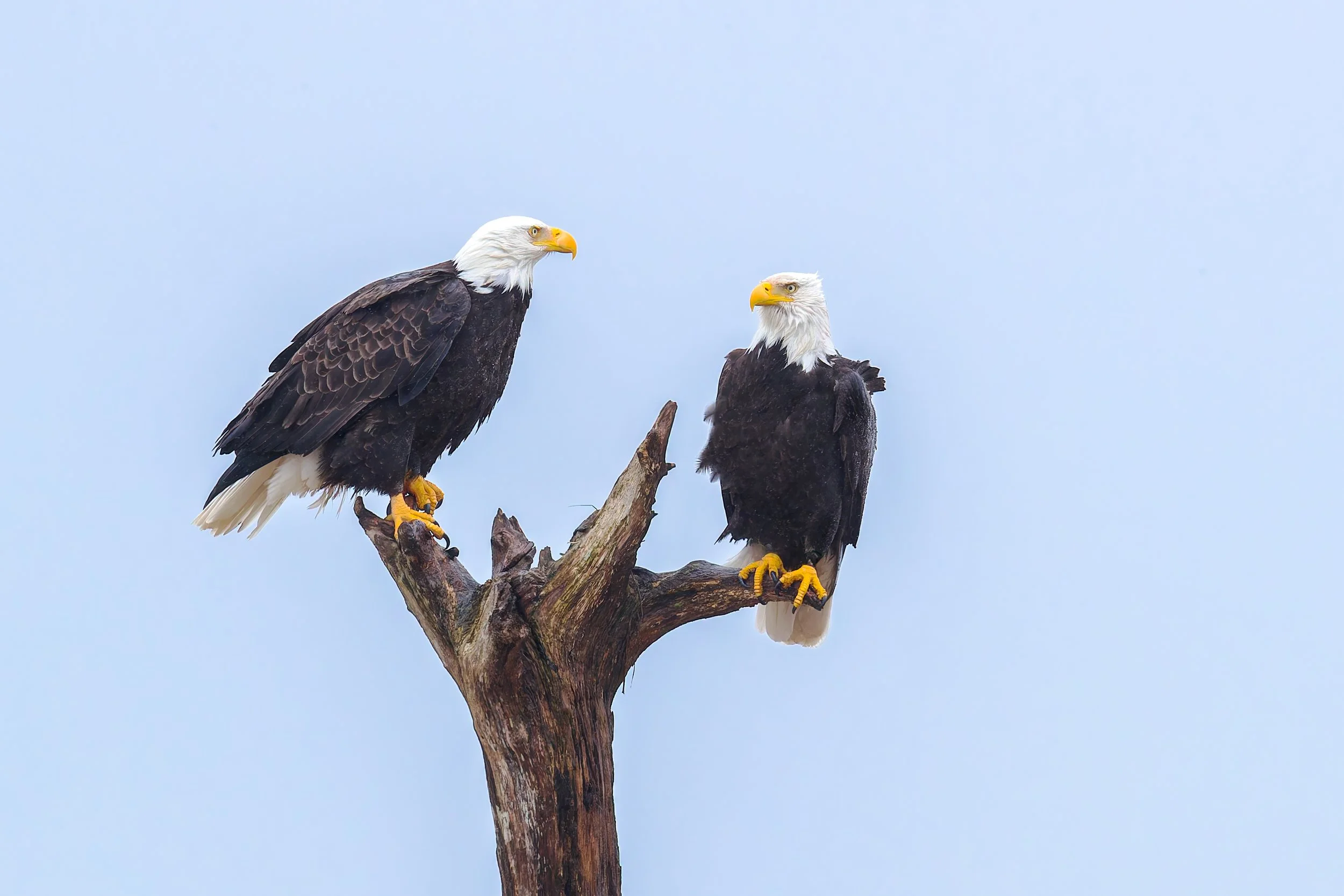
Bald Eagles have the word bald in their name to describe their white heads! (Photo by Mick Thompson).
Carolyn: Yeah, they have feathers on their head. Turkey vultures don't, they're bald. Bald eagle, lots of feathers on their head for sure. So this is one I actually had to look up. I knew that they weren't bald, but I wasn't sure why their name was like that. And it turns out the word “bald” comes from an Old English word. And sometimes people spell it b-a-l-d-e, sometimes people spell it b-a-l-l-e-d. But it means white patch or white-headed.
Mickenzee: Oh!
Carolyn: So that's accurate! They have a white head when they're adults for sure.
Mickenzee: Totally, we just lost that meaning over time.
Carolyn: Yep, so kind of true but different meaning for the word.
Mickenzee: Super. Carolyn and I love teaching about owls too. And every time we bring our owls, I mean everyone loves owls, so they've got a lot of facts to share with us. And I often hear “Owls can spin their heads all the way around, they can do a full 360. They can turn their head.” They can do pretty impressive stuff but I don't think they can spin their heads all the way around.
Carolyn: You're right, they can't go all the way around. So owls have a lot of mobility in their necks. Their eyeballs are too big, they aren't able to move their eyes in their head, so like, they can't roll their eyes. But to make up for that, they can move their neck a lot. And an owl can move their neck about 270 degrees. So if you were looking forward and you turned your head over your right shoulder and you spun your head looking to your back, and then you kept going, you could almost meet your left shoulder. That's a lot.
Mickenzee: That's really flexible.
Carolyn: Owls still have their vertebrae, their bones in their neck. They have their spinal cord, they have veins and arteries moving through there. And if they were to turn their heads all the way around, those things would get pinched like a garden hose. And that's not good for them, they need to be able to have those things working well. So they can move their head almost all the way around, but not quite.
Mickenzee: Still really impressive.
Carolyn: Oh yeah.
Mickenzee: Yeah, definitely. Okay thank you, Carolyn, for busting some myths with us today.
Carolyn: Any time.
Mickenzee: I look forward to busting some more with you next time.
Carolyn: Yes! Let's do this every, every year.
Mickenzee: Definitely.
-----
If you are interested in all things nature, please head to our website swibirds.org and click on over to the education tab where you can see our free lessons, games and activities. If you want to get outside with us, please check out our events calendar. Or if you have animal facts that you're curious if they're not quite all the way true, please submit them to info@swibirds.org with the title “Questions for QuACK”. Make sure to include your grade or the school you attend so I can give you a shout out.
Thanks for tuning in and I hope you join us next time on QuACK!
Check out SoWBA’s free lessons, games, and activities!
Get out and explore nature with us!
Make a donation to Southern Wisconsin Bird Alliance
Audio Editing by Mickenzee Okon
Transcription by Juanita Duarte
Logo design by Carolyn Byers and Kaitlin Svabek
Music: “The Forest and the Trees” by Kevin MacLeod
