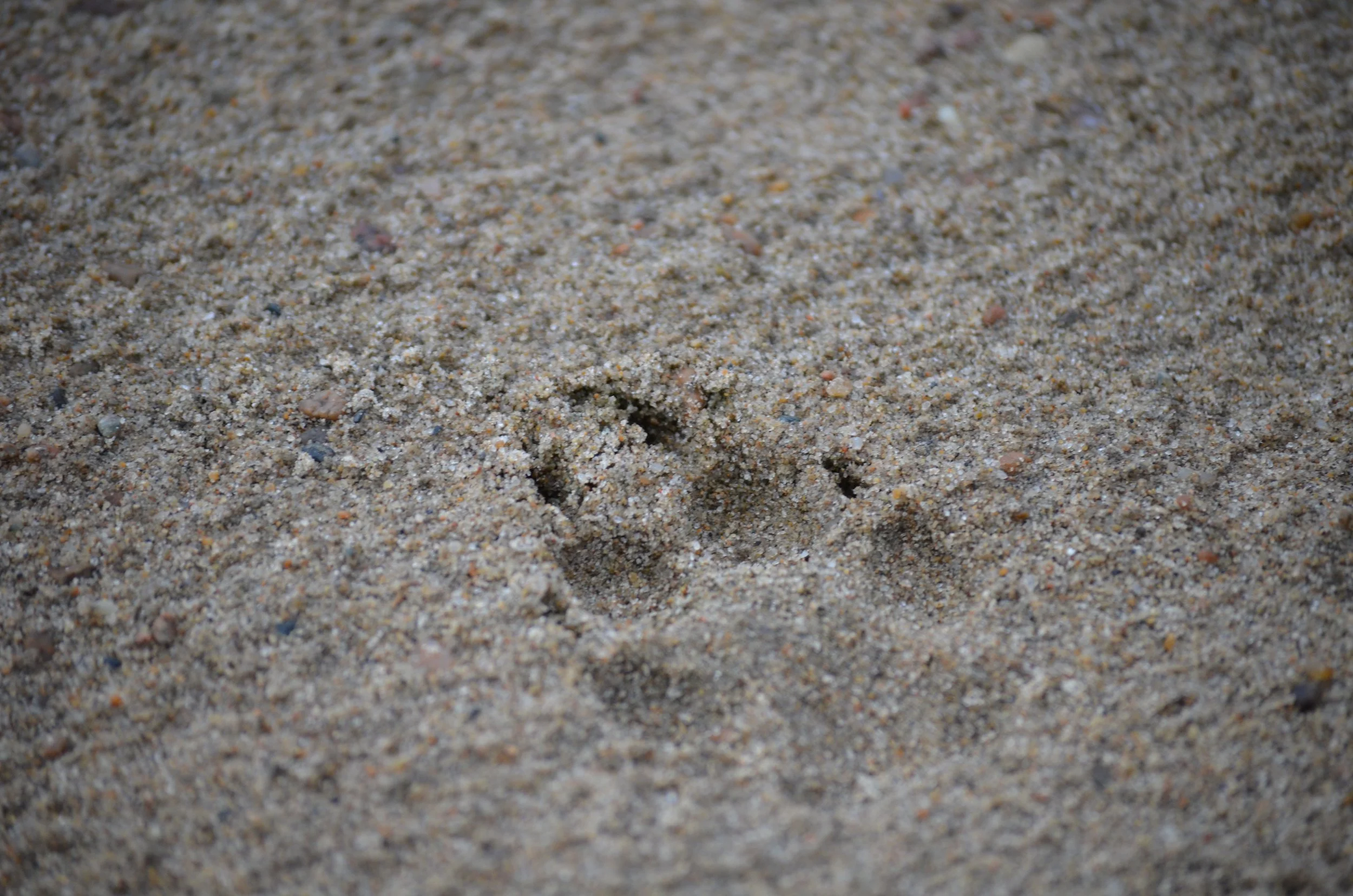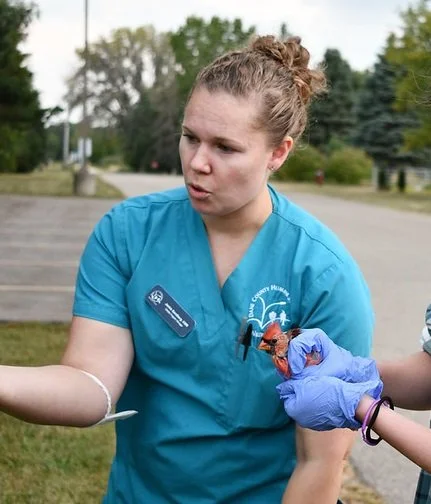
Jackie Edmunds in the field! (photo courtesy of DCHS)
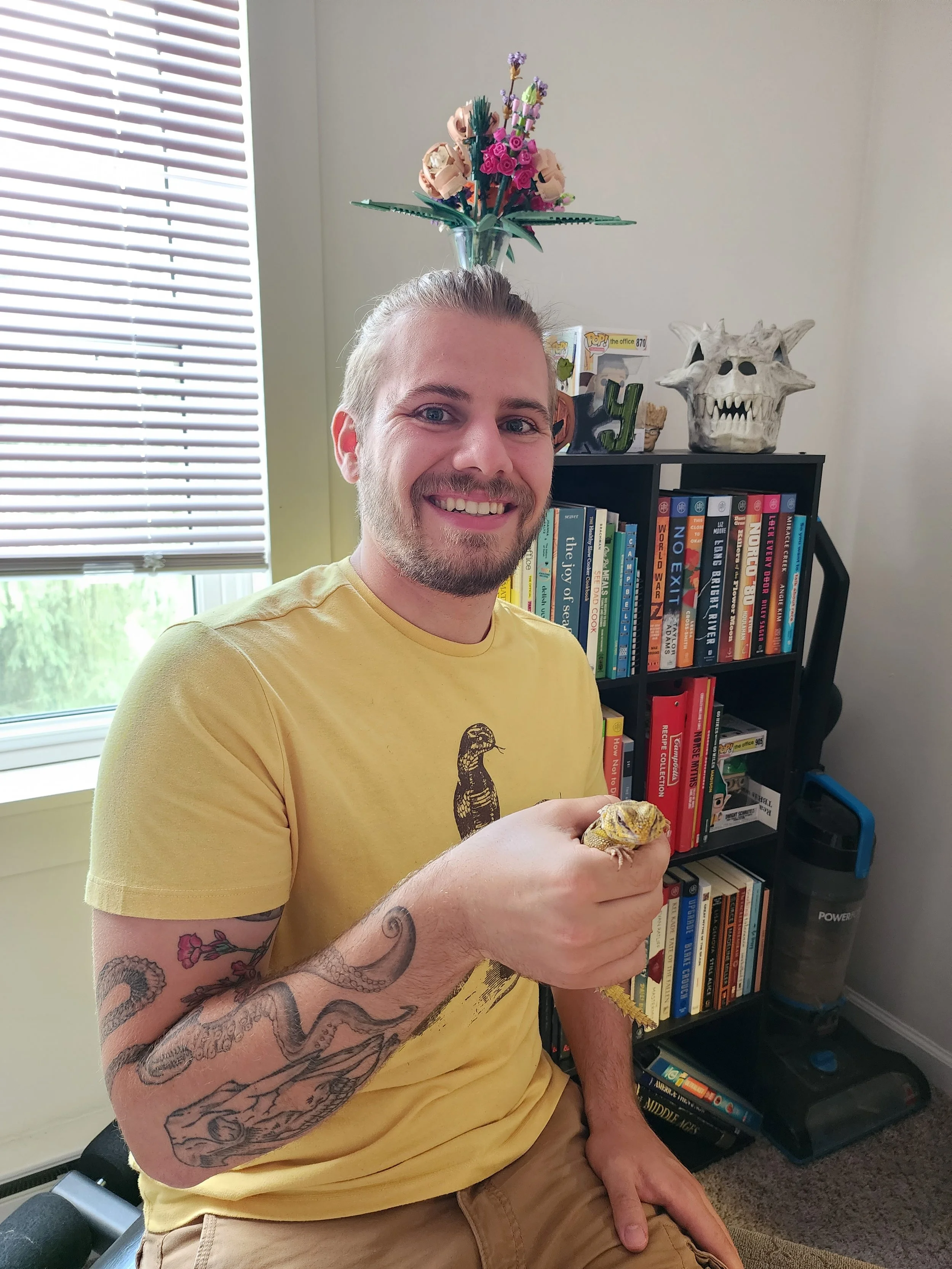
Dave Mackler with a reptile friend (photo courtesy of DCHS)
In this episode we answer questions like “What should we do when we see sick, injured, or orphaned wildlife?” and learn about all the care and expertise that wildlife rehabilitators can provide at the Dane County Humane Society (DCHS) Wildlife Center with Wildlife Program Manager Jackie Edmunds and Wildlife Rehabilitator and Educator Dave Mackler.
Subscribe to QuACK on Spotify, iHeart Radio, Apple Podcasts, or your favorite podcast app!
Transcription
Hey, and welcome to Questions Asked by Curious Kids, or QuACK, a podcast made by Southern Wisconsin Bird Alliance. This is a podcast where we gather questions about nature from kids to be answered with a local expert. My name is Mickenzee, I'm an educator, and I'll be the host for this series. This episode I'll be interviewing Jackie Edmunds and Dave Mackler. Jackie's been on the pod before in our Raptors episode. She's the wildlife program manager at Dane County Humane Society Wildlife Center, and Dave is a wildlife rehabilitator and educator. Today, they'll be answering questions about wildlife rehabilitation and giving us their expert advice for what to do when we see sick, injured, or even orphaned wildlife. For this episode, we're recording at the Humane Society, so you might hear some funny noises or some furry friends in the background making their voices heard. Okay, let's jump in with Jackie and Dave
-----
Mickenzee: All right, welcome back Jackie, thanks for joining us again. And welcome on, Dave. Today we're here to talk about wildlife rehab and what we should do when we see animals that look sick or maybe baby animals we’re worried that they're not getting cared for. And we're here at Dane County Humane Society in the Wildlife Center. So would you guys mind telling us what your roles are here?
Jackie: Well, I'm Jackie, and I'm so excited to be on this segment again, it's so much fun. I'm the wildlife program manager for the Humane Society and I've been doing wildlife rehabilitation now for about 16 years. So I run a program of seven full-time staff and a couple apprentices every year. Our wildlife rehabilitation program in general has 25 interns a year and 150 volunteers, and then also a side branch with our education program. So kind of in charge of all of the things, pretty much.
Mickenzee: Oh, wow, that's so awesome!
Dave: And I am Dave. I've been with DCHS for about two years now, some of that as an intern. I'm a licensed wildlife rehabilitator, and I am our new wildlife educator. I help spearhead our new education program.
Mickenzee: Great! That’s so awesome. So, one of the questions we get a lot at the Bird Alliance is like, what should we do when we see hurt or injured wildlife?
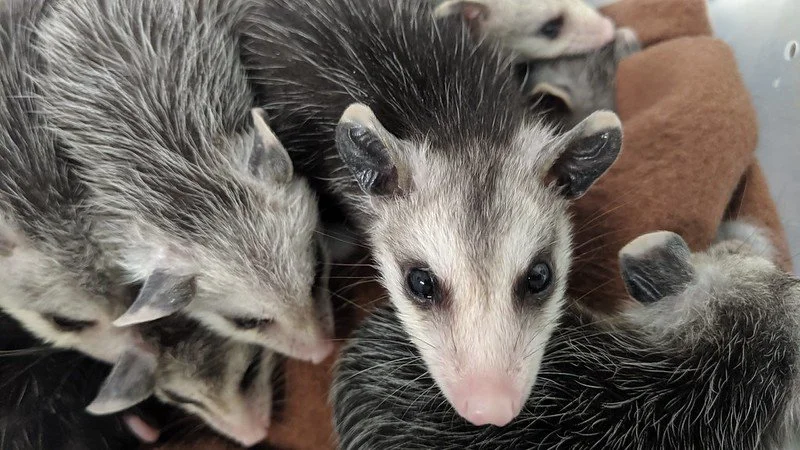
Baby Opossums (photo courtesy of DCHS)
Jackie: Yeah, I think it's good to know that not all wildlife are sick and injured, it's always good to know for sure. And usually sitting, watching, observing the animal first to be absolutely positive that it has some kind of injury is really important. Sometimes people will see an animal on the ground and they're not sure what age, what species it is. It all comes down to the time of year or if they saw something happen to an animal that'll make us kind of decide whether or not this animal should come in for treatment. So it's always best to contact a licensed wildlife rehabilitator no matter what the situation is to get advice first. So usually I tell people, look, listen, watch for a good period of time. I mean it could be 15 minutes, it could be 30 minutes. Just observing what you see, like what is the animal doing? How is it reacting? What's its attitude like? How close have you gotten to the animal for any reason so that you know okay, this animal is not acting normally for its situation. And then especially being careful during the baby season, which for us is like April through October, when baby animals are on the ground all the time when they're dispersing from their nests. And so sometimes people say “oh, it's sick or it's injured”, it might be totally healthy. So take a picture, describe it. Give us all the details as much as possible because that information helps us a lot so that we can figure out whether it is actually sick or injured right away.
Mickenzee: Right, sometimes I see Robin fledglings in my backyard and they just, they're awkward! And it's okay.
Jackie: Yeah! And there are some species, when I think of our native species of Killdeer is a great example. They will fake a broken wing just to try to get humans away from their babies or their nest sites. And so it might look like it's injured but might not actually be injured.
Micknezee: Yeah.
Jackie: And sometimes people might suggest an animal's also orphaned and the parents aren't there, but the parents aren't always going to directly be with their babies at all times. And that depends on species as well.
Mickenzee: Right, right. All animals have different ways of caring for their young or not caring for their young. Alright, and as wildlife rehabilitators, what care are you guys able to give here?
Jackie: Yeah, well once the animal has been contained and that's where, you know, if you're going to send us a picture or tell us “hey, this animal's injured” and we agree yep, it's injured, it needs help. We're hopefully able to take that animal for all of the next steps afterwards. So once it's safely transported to the wildlife center, that's where we can give it a full medical evaluation, we can give it all the treatment it needs. A lot of times for animals, keeping it in a quiet, dark space without any sort of stimulus around them is super important. The stimulus can really stress the animals out because they don't know that we're trying to help them, they think we're a giant predator that wants to eat them. And so we've now captured them in this very scary situation, put them in a box and said, okay here you go you're now in a brand new place in a wildlife center where there's, you know, human objects and activity around them. So the care that we provide is very hands-off afterwards. So after we’ve medically evaluated, given support, pain medications, fluids, everything else, diagnostics to figure out what's wrong with them, then it's really the treatment phase of keeping them in nice, quiet, safe environments, lots of food, enrichment, whatever is necessary for those species, until they can actually really get better. So we have a lot of different husbandry and care protocols for different species. So I'm not sure if you want to talk about some of the ones you've gotten to work with.
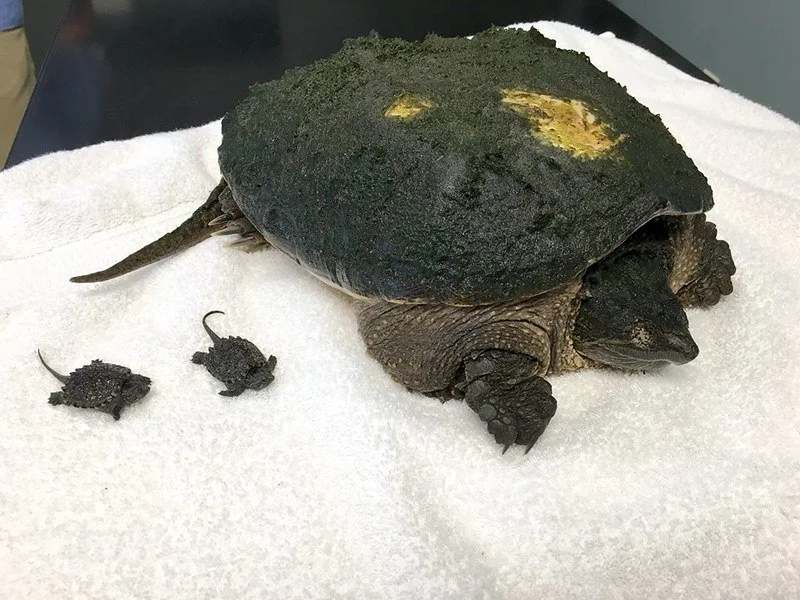
Snapping Turtle with babies (photo courtesy of DCHS)
Dave: Oh gosh, so many different species. I mean, we at DCHS take all native species, with a few exceptions. And there's a lot of variance between different species as far as what they need to thrive and what they have in their natural lives. So there's a lot of care that goes into planning. Setting up an enclosure for a Snapping Turtle is slightly different than setting it up for a Blanding’s Turtle, for example. There's a lot of variance between different bird species. And that is something that our team is able to provide that sort of the average person wouldn't necessarily have the know-how to set up a reasonable enclosure for a random animal that they found on the side of the road.
Mickenzee: Yeah, that's really important to recognize is, as an animal lover, like, you think you might know what's best for an animal, but you need a lot of expertise to set that up for them.
Jackie: And the kind of care that they're getting is so different than you could provide at home. I think that's another thing that, you know, when you think of wildlife rehabilitation, I think of veterinary medicine right away. And I think of, you know, being in that animal's place in the wild. If you were hit by a car, you know, a human hit by a car, that probably hurts a lot, and you would probably be sitting on the side of the road hoping that an ambulance would take you to the hospital, right? So that's my best way to describe how wildlife might be feeling, and we can't say that for a fact, but I'm pretty sure they're probably in a lot of pain if they have been injured. And so getting them to the hospital, which is a wildlife rehab center, right away, is crucial. You know, it’s crucial for their survival. And that's where we can offer that supportive care, besides all the food and the husbandry that goes for all of the species which is hard to know, you then can also have our veterinarians prescribing medications that they need and being able to give them the right kind of, you know, splints or wraps or cage rest or anything that they would need to heal from something like a fracture. You're not going to be able to do that at home typically without that kind of expertise.
Mickenzee: Totally, totally. So then what is your favorite success story here at the Humane Society?
Dave: Yeah, I mean, so many! But to, I guess, keep on the theme of baby animals. One of the things that we do here that I really like, we're going into turtle season right now. A lot of turtles, across the species spectrum, but we get a lot of Painted Turtles and Snapping Turtles particularly, I would say. But a lot of turtles right now are crossing roads. They do not lay their eggs in water, they lay them in soft soil, usually across the road from where they're hanging out. And so we do get a lot of hit-by-car turtles. Which I mean, in and of itself is just a good reminder to be aware of what we're doing as people. But, the lovely thing that we're able to do, even if it is a not so good outcome for the individual turtle, we are able to harvest the eggs. And we have a pretty awesome team of volunteers that incubate those eggs at home, and we're able to release those hatchlings where the mother was. So able to, I guess, carry on her line if it's a not so good outcome.
Mickenzee: Oh, that's so cool. How does one get the ability to incubate turtles at their house?
Jackie: Well, that's becoming a volunteer, so it is a very specialized process. So yeah, we have, you know 100, 150 volunteers with the program and they're all learning about the different wildlife care. So, you know, having that whole team of people together to do all of the different, you know, tasks that you might have to do for an animal for a day, one of those includes being a turtle volunteer. And there's a few specialized folks that do keep them in a very nice, you know, type of environment. Kind of specialized for humidity and temperature and the type of substrate that would be similar to what they'd be finding in the wild if their mom was looking for that soil. Maybe it's a little more sandy, a little, you know, whatever depth is needed. And we have to number all of the turtle eggs, we have to watch them, make sure that the eggs are safe, that they're not moved or touched or anything so that they have hopefully the best chance of being able to hatch appropriately. And then once they see, you know, the little turtle eggs starting to hatch, which is amazing, it takes them a little bit to get out of that shell and break open. And that's probably one of the fan favorites, I would say, in baby season, like Dave said, is seeing the tiny turtles the size of a quarter just coming out of their tiny ping pong ball of an egg. And so the volunteers are monitoring every day, once they start hatching, to make sure they get transported, you know, right back to the wildlife center and they can go into their enclosures to practice swimming, getting to eat their first time, getting a medical evaluation. So it's a really fun process, but yes, it's a very specialized type of volunteer position.
Mickenzee: Yeah, that sounds super cool! Any listeners, if you want to be a turtle volunteer, check it out. Okay, so this is still on the theme of baby animals. Our students often will maybe tell us a story, or talk about seeing baby animals all alone and feeling worried for those baby animals. What are signs that we could look out for that a baby animal is actually being taken care of or is totally okay on its own?
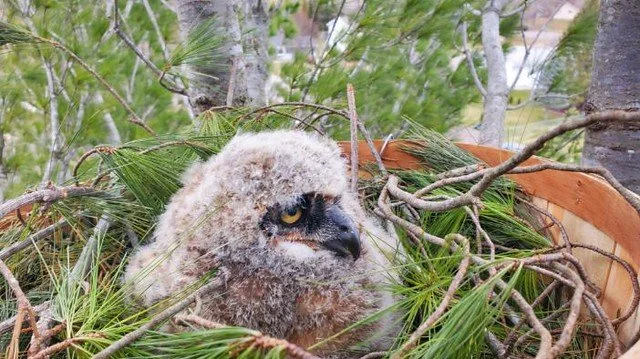
Owlet (photo courtesy of DCHS)
Jackie: I'll start a little bit just talking about songbird babies, because those are my favorite areas, I think. And there are so many different types of songbirds out there, they all nest in different areas. Some are high up in the trees, some are low down on the ground, some are in bushes, and they all have different timing throughout the year. So the baby animals, you know, they are going to either fledge from their nests or they might not. Baby birds if they fledge from their nest after mom has been sitting on them, maybe mom or dad incubating the eggs, they hatch and then the parents are coming to feed them. It could be every 15 minutes throughout the day, even shorter.
Mickenzee: Busy, busy.
Jackie: It's incredibly busy. It's a full time job here at the Wildlife Center to feed all of those babies that are here. But there is eventually that time where most of them will go to the edge of the nest, and they take that first leap of faith off the edge and say, I can do it. I even watched an entire Robins nest do this at my house last year, which was so exciting to watch the parents vocalizing until the very last one. And it was like 20 minutes of a back and forth conversation like, you can do it, buddy, you can go, you can go out of the nest. And it was so great, he finally did. So, you know, they go through that period of time where they're probably (anecdotally) scared to jump out, but they do have to eventually to learn what they need to do as a species. So I love seeing the Robins when they're here in rehabilitation go from the little hatchlings that are in their nest to then jumping out of the nest, and we call them nest hoppers at that age. And they go to our outdoor enclosures and that's where they're learning how to forage for insects on the ground, so we might put crickets and red worms and things out there. And they get so excited to see all the wiggly moving worms and learning how they can maybe do that in the wild, just like their parents would be teaching them. So it's so important that they get that type of enrichment and the training that their parents would otherwise give them in the wild. So for me, I think it's knowing that some animals are going to be on the ground and that's appropriate for them. I think Robins is the best example of that just because they forage for worms on the ground, they have to learn how to be robins. It could be 7 to 10 days before they're actually flighted. So they might be on the ground, look really awkward, and they're only flying a few, you know, hops or short distances doesn't mean that they're injured,
Mickenzee: Right.
Jackie: For us, we're looking at their, again their attitude. Are they really depressed? Maybe they're laying down on the ground. Maybe it's a hot day though, that could happen, you don't know if they're sick or maybe they're just trying to take a break from the heat. But it could be that that animal keeps his eyes closed all the time, and it looks like it's sleeping. You know, that's probably not the best situation, but we're going to pair it with what do we see visible? You know, blood, do we see a fracture, do we see anything else? Have you had some cases like that, any other injuries.
Dave: Yeah, I mean I think the big thing to me and the thing that I talk to during my educational groups is lean on your local rehabilitators. Not everyone has experience identifying these things, like Jackie was saying, broken bones, bleeding, signs of dehydration, you're not necessarily going to recognize that. And there is, again, a ton of species variation. You were talking about birds fledging from the nest. So we're sort of trained to think like, oh it's okay, it's normal for a fledgling to be hopping around on the ground. But then you have things like Barn Swallows who are able to fly right when they leave the nest. So there is a lot of unique variation and the average, I guess, member of the public shouldn't be expected to know all those things off the top of their head. I mean, we could sit here talking about individual babies all day, but at the end of the day, there are rehabilitators in everyone's area who are eager to help wildlife. And before you intervene in any way, the best thing to do is take a picture of it, monitor it, and reach out to a local rehabilitator who can assist you with the best next steps for that.
Micknezee: Totally.
Jackie: And like what Dave is saying, if you were to see that swallow on the ground, we'll know right away, that's not normal comparing it to that Robin. So again, yeah, not everybody knows all of that, but we're trained to hopefully study that information and be able to give you that best advice. So although the generic advice is out there like, oh you see a baby bird on the ground leave it be, well it depends on what species. Other things I would mention would be if you know for sure maybe a dog or a cat or something has maybe bitten a baby animal. We see a lot of interactions with companion animals and wildlife during the summer season when they're out of the nest, that's almost always going to indicate some sort of treatment or evaluation is necessary by a rehabilitator. You can always call to ask, you know, is it better to be safe than sorry? Always better to be safe, call, ask. Even if it's good news and we say, hey, you know, this is okay, we can put this animal back to the care of their parents, that's going to be the best thing. Great. And if not, if we notice something from a photo or video, we're going to say, hey, this looks like this is abnormal, we should have you bring it in. And even jumping from those nests, they can fracture toes and feet and legs and things. And so they go from 60ft trees down to the ground, you just don't know for sure. And again, that monitoring effort really helps I think. So there's some very clear, obvious things, like you see the blood, you see the fractures. Those are, okay probably going to be a yes to come into rehabilitation. But regardless it's best to monitor first and then hopefully safely contain the animal when instructed by a licensed rehabilitator.
Mickenzee: Yeah, so just lean on the knowledge of experts in your community. That's great. Thank you so much for taking time out today and teaching us and giving us some advice on what to do. Thanks!
-----
If you are interested in learning more about Dane County Humane Society Wildlife Center or volunteering with them, please head to giveshelter.org. If you're interested in learning more about Southern Wisconsin Bird Alliance programs and resources, please head to our website swibirds.org and check out free lessons, games and activities, the event calendar, and even our community science programs.
If you have a big nature question that you'd like to have answered, please have a grown up or teacher submit your question to info@swibirds.org with the title “Questions for QuACK”. Make sure to include your grade and the school that you attend so I can give you a shout out. Thanks for tuning in and I hope you join us next time on QuACK!
Check out SoWBA’s free lessons, games, and activities!
Get out and explore nature with us!
Make a donation to Southern Wisconsin Bird Alliance
Audio Editing by Mickenzee Okon
Transcription by Juanita Duarte
Logo design by Carolyn Byers and Kaitlin Svabek
Music: “The Forest and the Trees” by Kevin MacLeod