
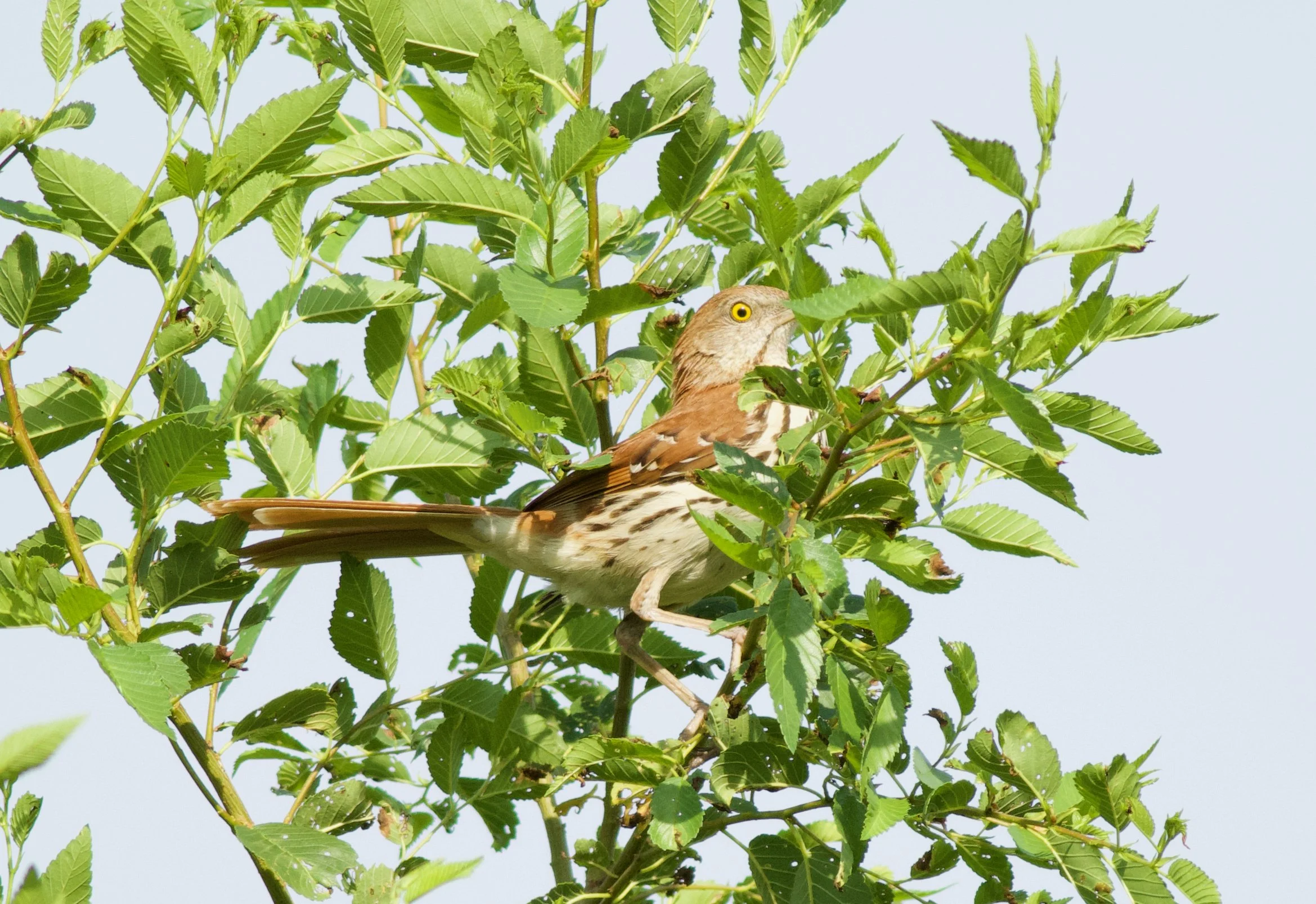

If you’ve ever heard a noisy bird echoing from a nearby shrub, thicket, or woodland edge, you may be in the company of a Brown Thrasher, the only thrasher species east of the Rocky Mountains. Although Brown Thrashers have a recognizable voice and rhythm, they do not have a singular distinct song. Instead, they piece together over 1,100 different song types, often borrowing from other birds like thrushes, Northern Flickers, Northern Cardinals, White-eyed Vireos, and more. Despite how varied their songs may be, it’s obvious when you’re in their midst due to their constantly repeating ‘phrases’ in twos. The Cornell Lab of Ornithology’s All About Birds gives the example, “plant a seed, plant a seed, bury it, bury it, cover it up, cover it up, let it grow, let it grow, pull it up, pull it up, eat it, eat it.”
Most of the time, I hear a Brown Thrasher before I see it. As shrub nesters, they do a good job of hiding within the thick brush of woodland edges, tangled thickets, and hedgerows. However, once you hear their repetitive song or their noisy feet in the ground litter, it’s relatively easy to spot their deep, auburn-brown back and long tail. If you catch them in the sunlight, they almost appear bright orange. Up close, they have a stern-looking face with striking yellow eyes; a sharp, down-curved bill; and a streaky white and brown breast.
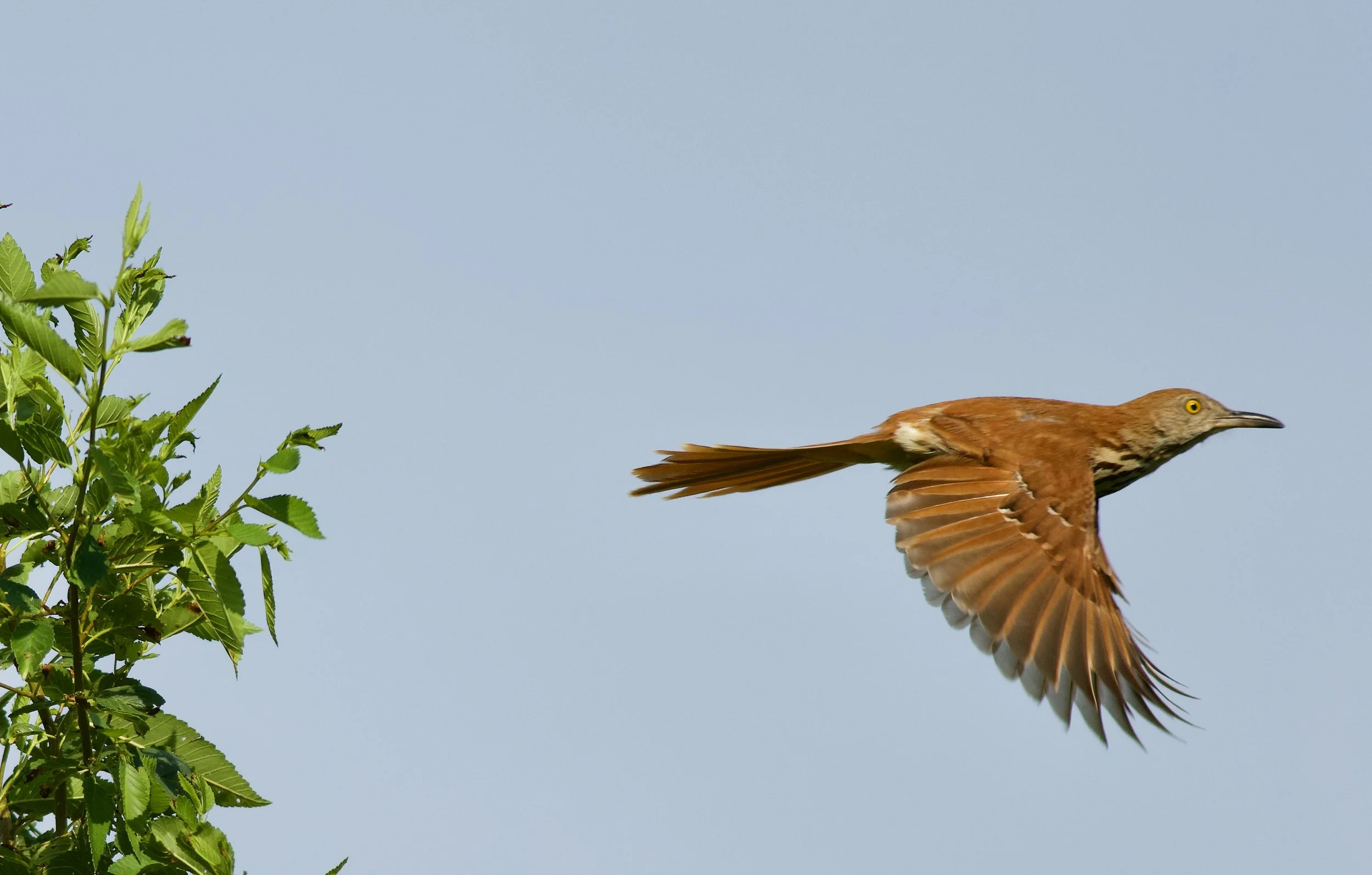
A Brown Thrasher in flight. Notice the yellow eye and down-curved bill (photo by Arlene Koziol).
This spring, I’ve had no problem spotting them because a pair has been consistently hopping around in the backyard at Goose Pond’s Kampen Road residence. It’s been such a treat to watch one of my favorite, and somewhat elusive, birds right out my window. Brown Thrashers spend a lot of their time on the ground—foraging, running, walking, hopping, or chasing each other. The pair in my backyard have been no different, and it’s been fun to watch them rummage through the grass. Brown Thrashers are omnivores, but primarily eat insects in addition to seeds, fruits, and nuts. All About Birds describes their ground foraging habits as “sweeping their bills through the leaf litter and soil with quick, sideways motions.” However, what I observed out my window differed from this. Instead of sweeping their bills through leaf litter, they repeatedly stabbed their bills into the ground like a woodpecker on a tree! As I watched them, the name ‘thrasher’ started to make more sense.
If you’re looking to add Brown Thrashers to your bird list, visit one of Southern Wisconsin Bird Alliance’s sanctuaries and walk along shrub lines and woody edges. There have been quite a few Brown Thrashers observed at SoWBA’s newest property, Hillside Prairie Sanctuary, in dogwoods, plums, and along fencelines.
Written by Emma Raasch, Goose Pond Sanctuary land steward
Cover image by Arlene Koziol. A Brown Thrasher hidden within in a green leafy shrub.
