

“This little musician has explored the whole realm of sound, and condensed its beauties in perfection into one short song.”
The Field Sparrow is one of four species of New World sparrows that have been documented nesting at Fair Meadows Sanctuary, the others being Song Sparrow, Swamp Sparrow, and Chipping Sparrow. Every year in mid to late April, the first migrating Field Sparrows show up and establish territories in their preferred habitat: brushy fields and shrubby meadows.
The common name of this bird is a bit inappropriate, since only certain types of fields serve as suitable habitat. Agricultural fields and wide open grasslands are unattractive to Field Sparrows—they prefer fields that are somewhat grassy in nature and contain at least scattered small shrubs with elevated perches. The species can also be found along the edges of forests where trees and shrubs blend into more open areas. These habitats are known as early successional and are only suitable for a relatively short period of years without disturbances, such as burning or removal of nearby taller woody vegetation.
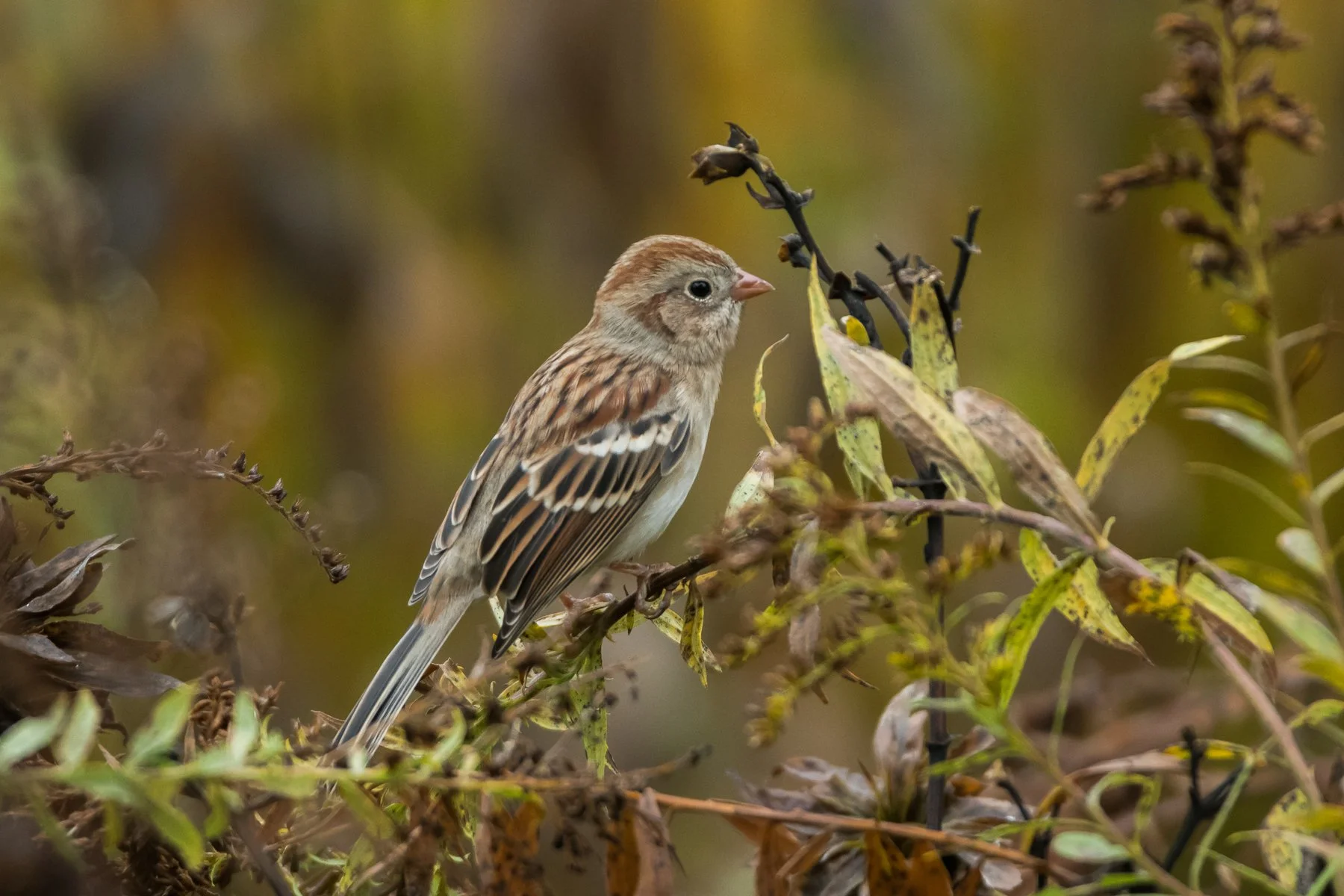
Adult Field Sparrow in the prairie in autumn (photo by Gary Shackelford).
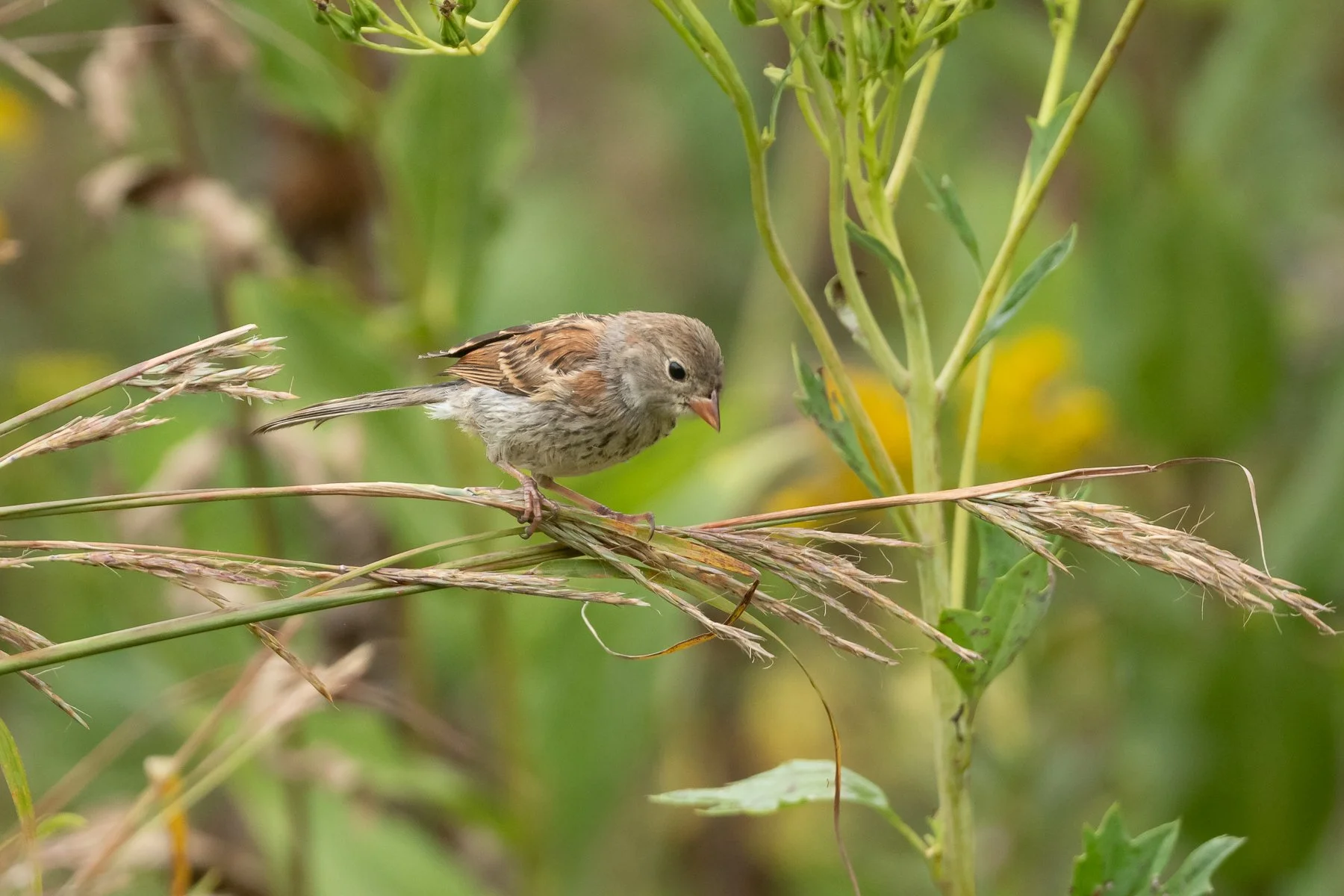
This small, warm-toned sparrow has a rusty-brown cap with a pale gray median stripe, grayish face with a rufous eyeline, white eye ring, two white wing bars, rusty streaking along the back, and unmarked, pale underparts. Its pinkish bill and legs are distinctive. Juveniles have a buffy streaked breast and are duller in color, lacking the bright rusty crown and eyeline of adults.
The exquisite, lilting song of this denizen of brushy fields and shrubby meadows, so beautifully described by Simeon Pease Cheaney in his 1892 book, Wood Notes Wild, is perhaps the beginning birder’s first introduction to the Field Sparrow. Known as the “simple” song, this familiar vocalization is a series of short, slurred whistles, usually at the same pitch, that begins with a slow rhythm and then accelerates into a fast musical tremolo. Its cadence has been aptly described as that of a bouncing ball that has been dropped. Less common is the “complex” song, given by males that hold territory when they attempt to eject an intruder. The order of notes in the more harsh complex song is the reverse of that of the simple song, beginning with a tremolo and ending with more widely separated slurred notes. The vocal repertoire of Field Sparrows also includes many different calls that serve various purposes.
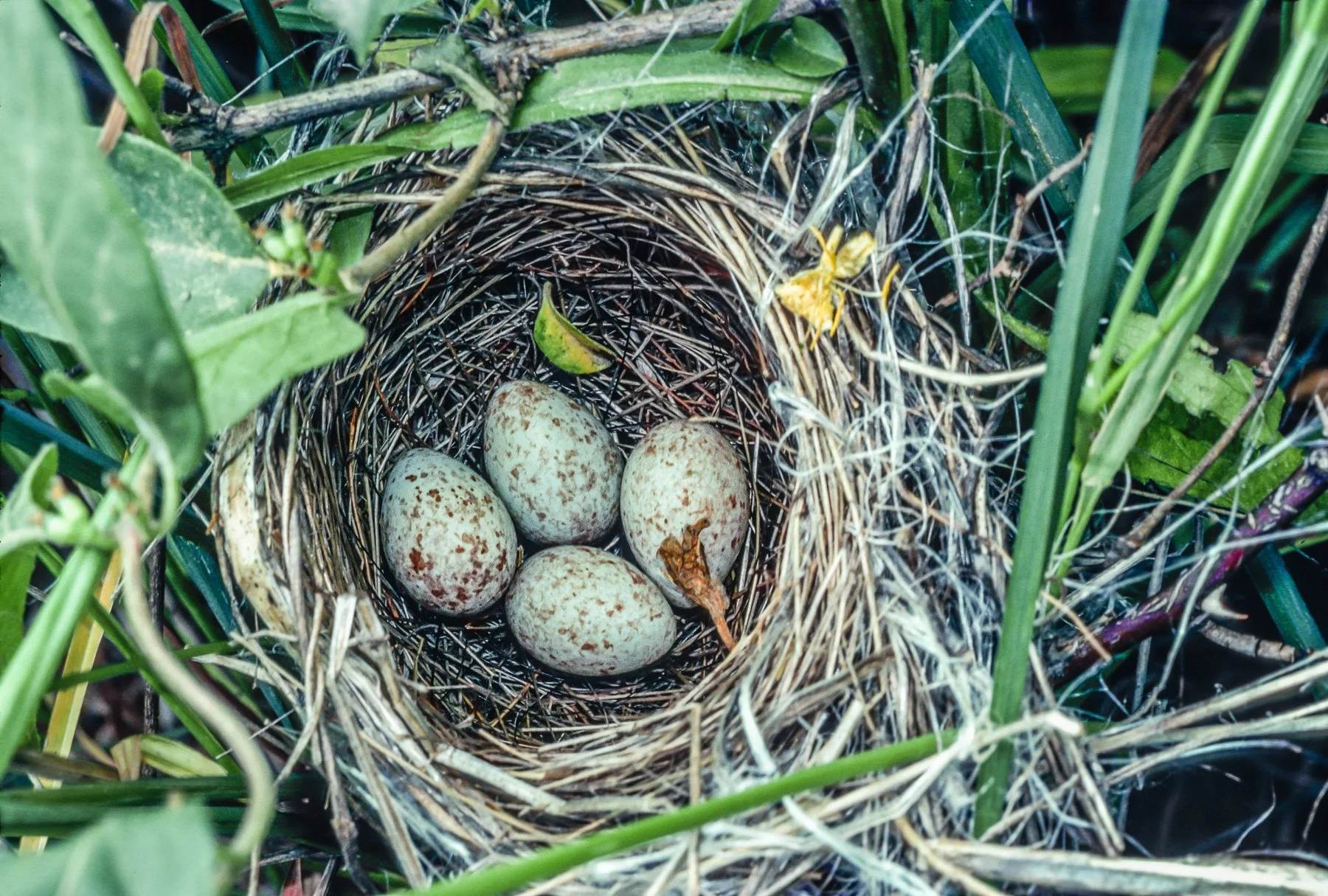
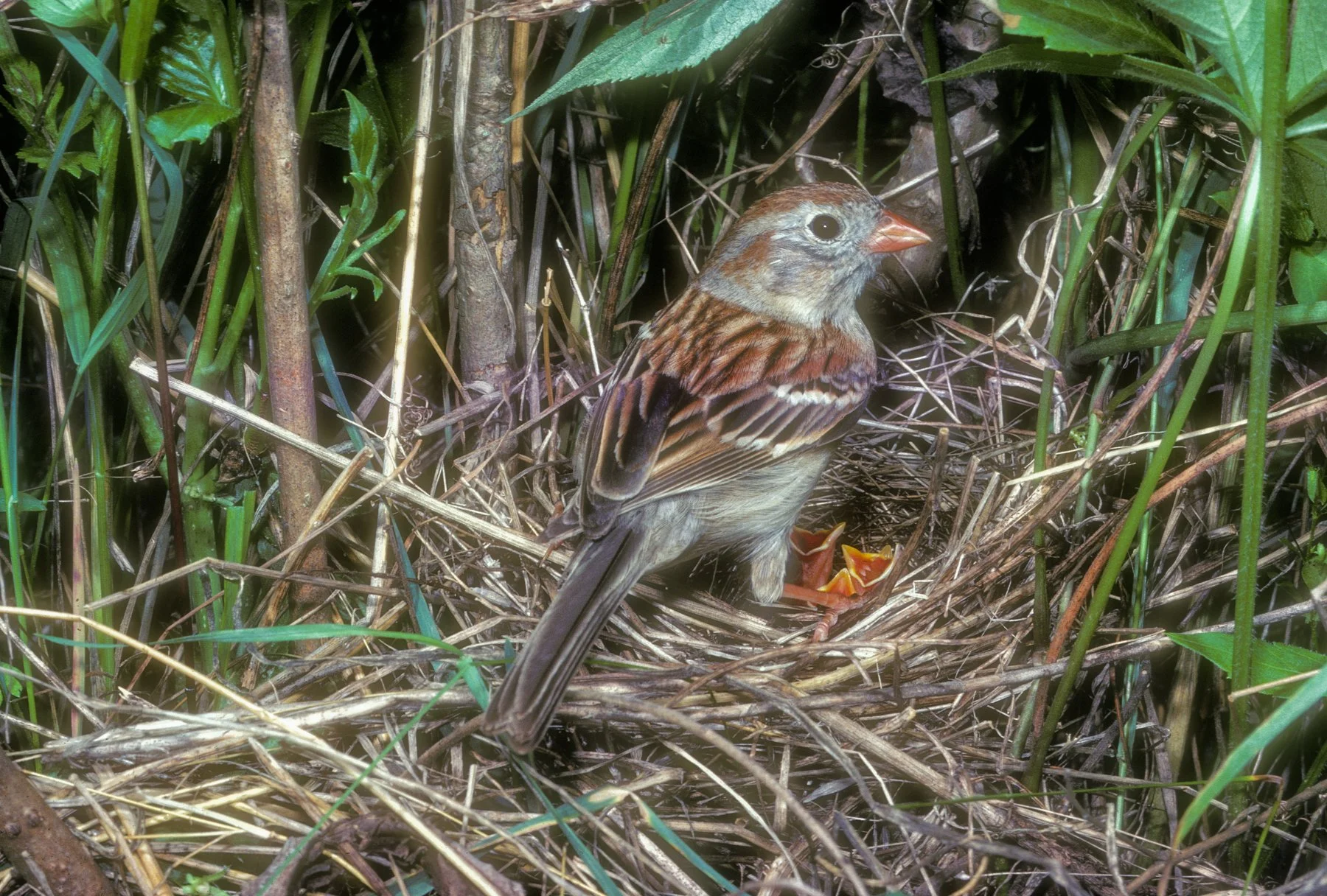
Breeding territories range from about two to six acres. Larger territories are associated with more open grassland. Field Sparrows usually breed more than once per season, building a new nest each time. The number of nesting attempts is related mainly to the rate of nest loss. The nest is a small cup of grasses, lined with finer grasses. Early nests are usually placed on or near the ground, later ones as high as a few feet above ground in low thick shrubs or small trees. The female builds the nest, often accompanied by the male, who may offer nesting material. The eggs are white or pale bluish, and speckled with small brown dots. Clutch size is two to five, usually three or four. Field Sparrow nests are heavily parasitized by Brown-headed Cowbirds, but the success rate for cowbirds is poor because parasitized nests are commonly deserted.
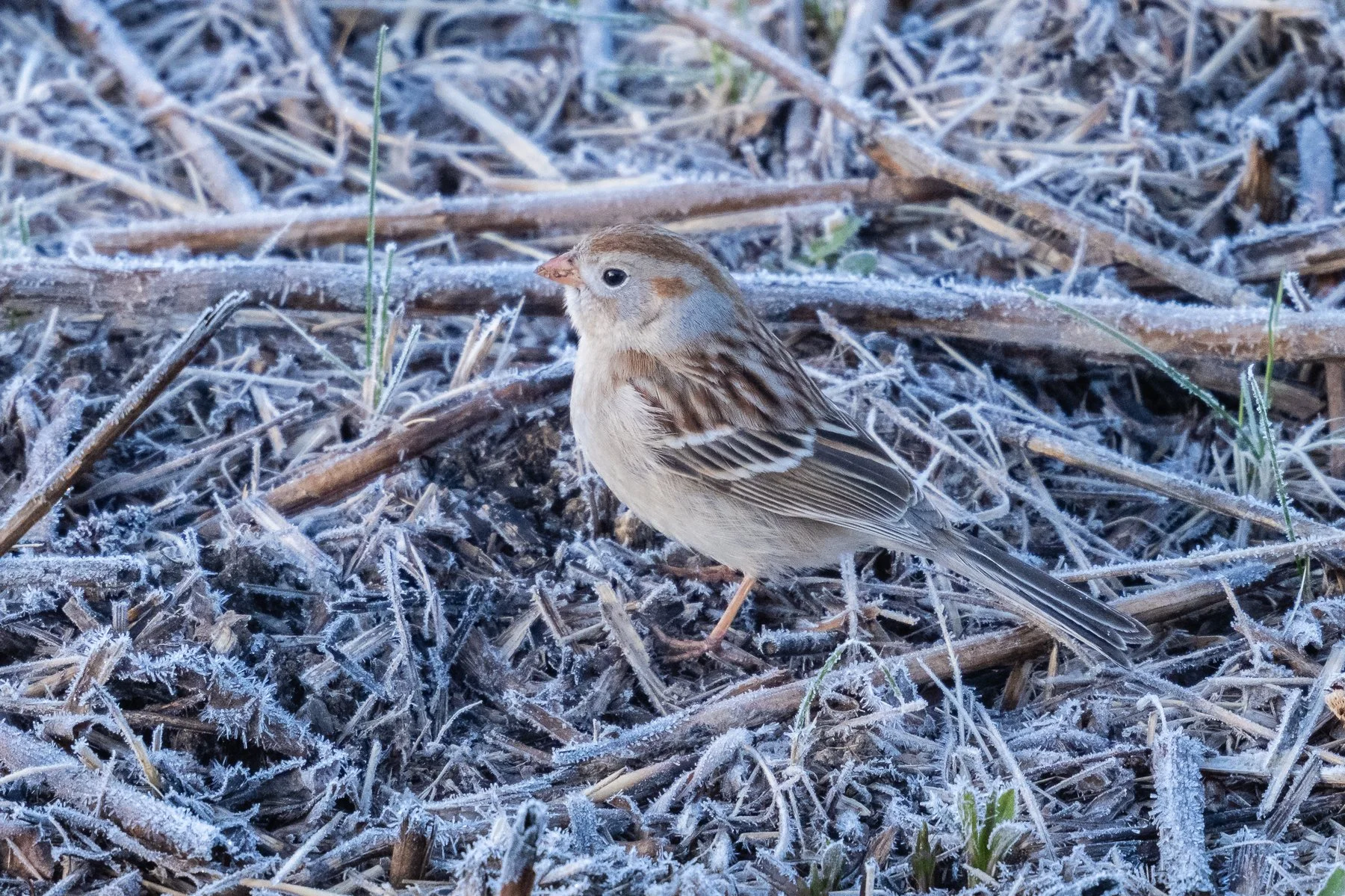
Field Sparrow feeding on frosty ground in early spring (photo by Gary Shackelford).
Field Sparrows are a source of enjoyment for us at Fair Meadows during all but the winter months. In spring and early summer, we hear their simple song and observe them in three separate prairie tracts where they have reliably nested for several years. One year, we even saw a few birds feeding on the frost-covered ground in one of our prairies on April 1. In late summer, we enjoy watching them as they join other sparrows in our prairies to feed on the seeds of native grasses and forbs (I have described this activity in a previous Friday Feathered Feature).
Written by Gary Shackelford, Fair Meadows Sanctuary manager
Cover image: Juvenile Field Sparrow in September. Note the streaked breast, the grayish head lacking a rusty crown, and the pinkish bill and legs (photo by Gary Shackelford).
