bird collision corps

Ep 021: Community Science with Brenna Marsicek

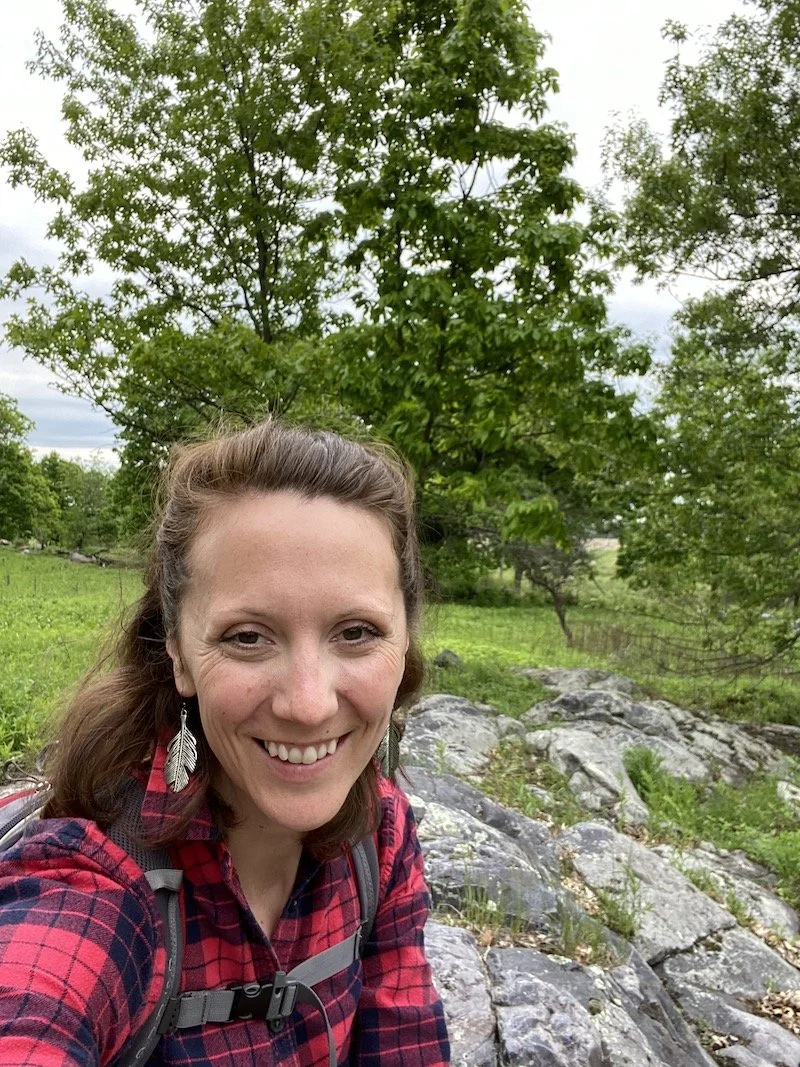
Brenna Marsicek out in nature. (photo courtesy of Brenna Marsicek)

In this episode we talk about Community Science and how anybody, even kids can get involved with our in-house Community Science extraordinaire, Brenna Marsicek, the Director of Outreach here at Southern Wisconsin Bird Alliance!

Find out more ways to get involved with our community science programs here!

Subscribe to QuACK on Spotify, iHeart Radio, Apple Podcasts, or your favorite podcast app!

Embed Block
Add an embed URL or code.

Transcription

Hey and welcome to Questions Asked by Curious Kids, or QuACK, a podcast made by Southern Wisconsin Bird Alliance. This is a podcast where we gather questions about nature from kids to be answered with a local expert. My name is Mickenzee, I'm an educator and I'll be the host for this series. This episode, I'm back with Brenna Marsicek, our Director of Outreach here at Southern Wisconsin Bird Alliance, or SoWBA. And today we'll be talking all about community science and how to get involved. Okay, let's jump in with Brenna. 

-----

Mickenzee: Welcome back, Brenna. We're so glad to have you on again. This episode, we're highlighting community science and how anybody, even kids, can get involved. As the Director of Outreach here at Southern Wisconsin Bird Alliance, you're involved in so many community science projects. And even the last time you were on the show, we were talking about Bird Collision Corps, which is one of our community science programs. But that's just the beginning of our projects, right? 

Brenna: Right. 

Mickenzee: But before we dive into all those details, could you tell us about, you know, what is community science and why it's important for people to get involved? 

Brenna: Yeah, definitely. Yes. So community science is one of the names of this idea that regular people can do real science and contribute to a shared database that professional scientists analyze and use the results of to better research and study something. It goes by other names too, community science is a really common one, citizen science, participatory science. It goes by lots of different names, but it all generally describes the same thing: that you don't have to have a degree in biology or any other type of science to do research, that regular people can participate in these programs and help study a research topic. It also means that there's a shared protocol, that everybody follows the same steps to collect data, and that all of the data are put into one centralized database that scientists are able to review that information from. What makes community science extra awesome is when there's a way for the participants to do more than just data collection. If they're able to think about some of the whys and ask some of their own questions, that maybe they just kind of keep to themselves and observe as the community science program goes on. Or maybe they share those observations or questions with the person who's running the program, or maybe they are even able to help on the back end with understanding what the data that's been collected looks like and what it means. So a really good community science program is more than just community data collection. It's like actually following many of the steps of science that really gets people involved and excited about the research topic. 

Mickenzee: Yes, it's really building and enhancing critical thinking and those science skills that maybe you don't get to exercise every day.

Brenna:  Absolutely. If you're volunteering to do something like this, you're probably pretty interested in it. And so it allows you like this really close up look and deep dive into a topic that you already have some interest in, and allows you to learn so much more than you would be able to just by, you know, like watching a story on the news or talking to a friend about it. It allows you to actually, like, get into the topic pretty deeply.

Mickenzee: Yeah, and even the engagement of lots of participants tells the community, you know, what we care about together. 

Brenna: Absolutely. 

Mickenzee: It builds connection like that, I love that. And I mean, since this is a show for kids, what are some of the benefits of kids getting involved in community science? 

Brenna: Oh, that's a great question because citizen, or community, science is really for anyone of any age. A lot of times the data that are collected have to be submitted online. With youth, it kind of requires that there's an adult, a trusted adult involved, so that that data that the kid collects is still able to be safely uploaded to the internet, you know. So I just want to start with that, to make that clear, because there are so many different benefits to kids participating and making sure that there's an adult who can help facilitate that is really important too.

Mickenzee: Absolutely, yeah. 
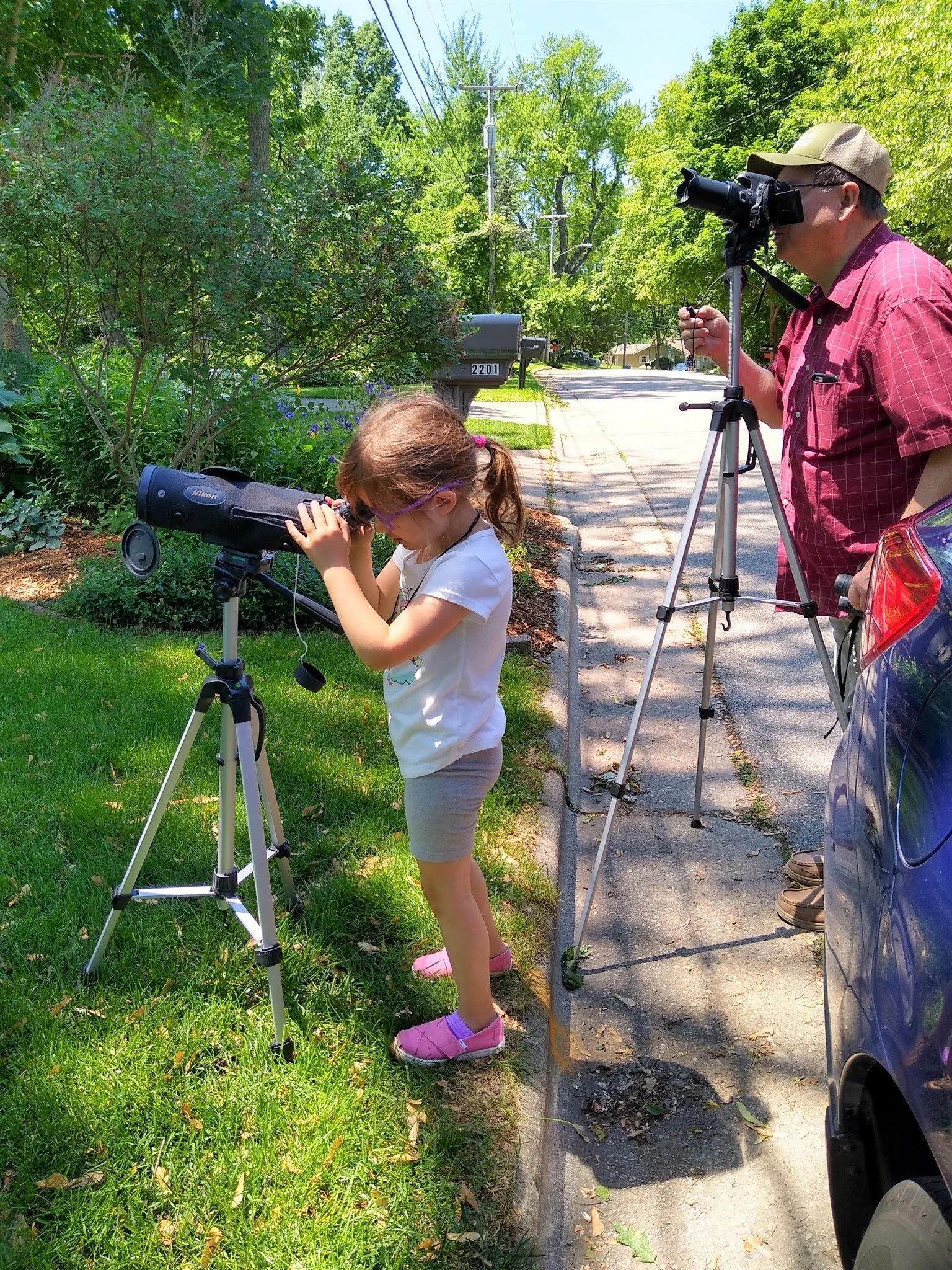
A young birder helps her grandparents monitor Bald Eagles for the Bald Eagle Nest Watch Program (photo by Lyn Boyle)

Brenna: So, you know, kids have such a natural and fabulous curiosity and imagination for the world around them that hasn't been sort of tamped down by like, adult realities. You know, it's really awesome for kids to be able to explore some of these topics, like Bald Eagles, for example. We have a number of kids that go with their parents or grandparents or neighbors to monitor a Bald Eagle nest each week. And by doing that, you're spending a whole hour, in the woods a lot of times, staring at these eagles. And it sounds kind of boring because you're just like staying in one place, but a lot happens in that one hour that is more than just Bald Eagles. So you're looking at Bald Eagles and you're curious about like what that prey item in the talons of that Bald Eagle flying into the nest? Like, what are they eating in there, and will I see any of the babies yet today? But then you also observe all these other things that are happening around you, like, oh, there was the first frog song that I heard for the year, or like, oh, I wonder what that bird that's bopping around over there in the shrubs is. Or, you know, like you see a muskrat swimming through the water and you're wondering, like, where is it going and why, and where did it come from and what is it doing? 

Mickenzee: Yeah!

Brenna: So, you know, there's so many ways to lean into that, like wonder and curiosity that goes well beyond the exact question that you're out there to research. And kids are so good at being observant about all the different things that's going on around them that I think kids are like kind of the best people to do community science because of that, you know, because they just notice so much and they're so curious about basically everything.

Mickenzee: Yeah, I like that you touched on the benefit going both ways. That the program benefits from having kids because of their curiosity and that keen observation, but it's also benefiting the kids.

Brenna: Absolutely. And, you know, I also say that kids are so good at convincing adults that things matter. 

Mickenzee: Yes!

Brenna: And so when a kid is involved in a Bird Collision Corps survey, that kid is really good at talking to other people about why window collisions are a problem for birds, and that there's stuff that we can do about it. It doesn't have to just stay as it is, that we can solve a problem and maybe even study our own windows at home and be able to transfer some of those community science programs into smaller settings in different places. And kids are just, they're just so good at that. 

Mickenzee: Yes, their voice matters and has a great impact.

Brenna: Absolutely. 

Mickenzee: All right, and now I want to talk a little bit about our projects here at SoWBA that are really good for kids to get involved with. 

Brenna: Yeah, we have a lot. Which is really fun, and they happen at different times of the year. 

Mickenzee: Oh, awesome! 
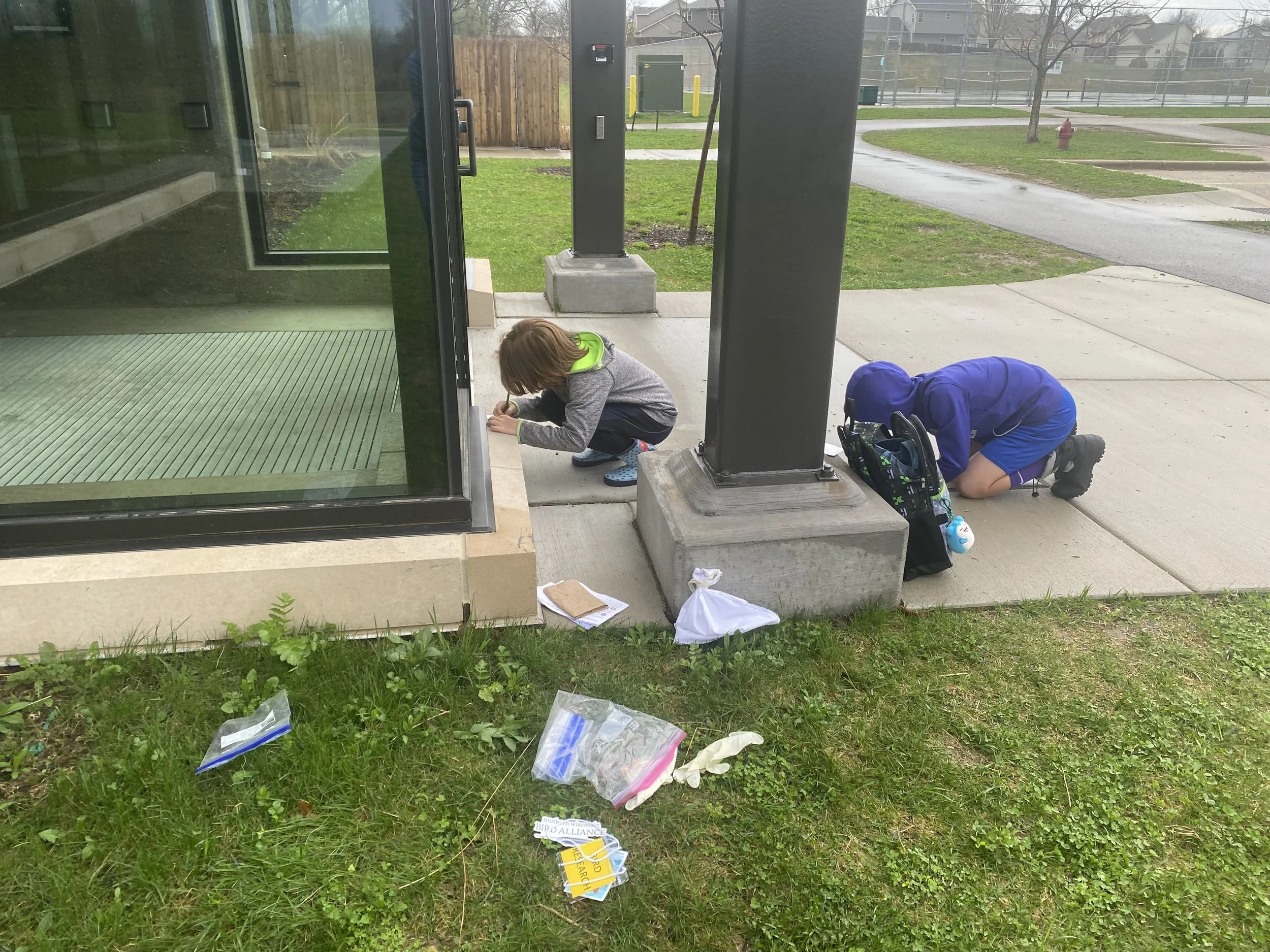
Young Birders do a spring Bird Collison Corps survey. Many hands make light work! (photo by Brenna Marsicek/SoWBA staff)

Brenna: Yeah. So no matter like what season we're in, there's usually something going on that kids can get involved with. But I will add that all of them require an adult to participate with. So let's see, let's start with where we are now in Spring. So right now this week, in middle of April, while we're talking, Bird Collision Corps just started up. So these are surveys that involve walking around the outside of a building and looking for any evidence that a bird has hit a window at that building. A lot of times that evidence is actually a dead bird. Sometimes the bird has been injured, and then we help that bird get to the wildlife center so it can be rehabbed and released. And sometimes it's just a smear on the window. So it really uses those, like, detective skills to observe those pieces of evidence. My kids are ten and nine, and they do Bird Collision Corps surveys with me each week. And they're very, very into it and really good at it, you know, because they're such good detectives. So that's a really fun one. It's kind of fun in an odd way because, you know, it's really hard to find a dead bird. 

Mickenzee: Yeah. It's sad. 

Brenna: It's really sad and discouraging. But on the flip side, you will never see a bird that close up and that still again. And you can, like, really notice some awesome coloring and like the size and the weight of that bird. And you can, it can take some time to actually notice those things about that individual bird and honor that the bird is amazing in its own right and unfortunately had to die that way. So that's one program. We also have Bald Eagle Nest Watch going on right now. I mentioned that is the program where people go out to a Bald Eagle nest once a week for an hour each visit through the whole nesting season. And eagles are one of those birds that start nesting really early in the year in February usually. 

Mickenzee: Woah!

Brenna: So it's really cold when we start our Bald Eagle Nest watch monitoring. But the eaglets usually take quite a while before they're big enough and strong enough to fly. So at the end, our volunteers are watching big baby eagles in like, June. 

Mickenzee: That’s so cool!

Brenna: You know, so it's a good chunk of the year and you go through a full, you know, a couple of seasons watching these eagles, which is really fun.

Mickenzee: I know some of our classrooms that we work with like to watch the eagle nest cams, the live cams of Jackie and Shadow. And this would be a really great connection to see eagles in our own area. 

Brenna: Yeah, definitely. And those nest cams are really great because the cameras are pointed into the nest, whereas our volunteers are standing back a little ways, they’re on the ground, they can't see into the nest. But again, it's using those detective skills. You're watching the body language of the adults, like are they sitting? Are they not on the nest? Are they feeding? And then eventually you can see the little baby's head stick up over the edge. So, you know, it's really fun to have those nest cams that you can watch and actually see what's happening in the nest. And then it's like, kind of cool to be like, okay, so what's going on from the ground? I can't see exactly, but I'll have to like really…

Mickenzee: Use it to exactly piece together like, okay, this is probably what's happening in there. 

Brenna: Yeah, right. We also have our Kestrel Nest Box Monitoring program going right now.
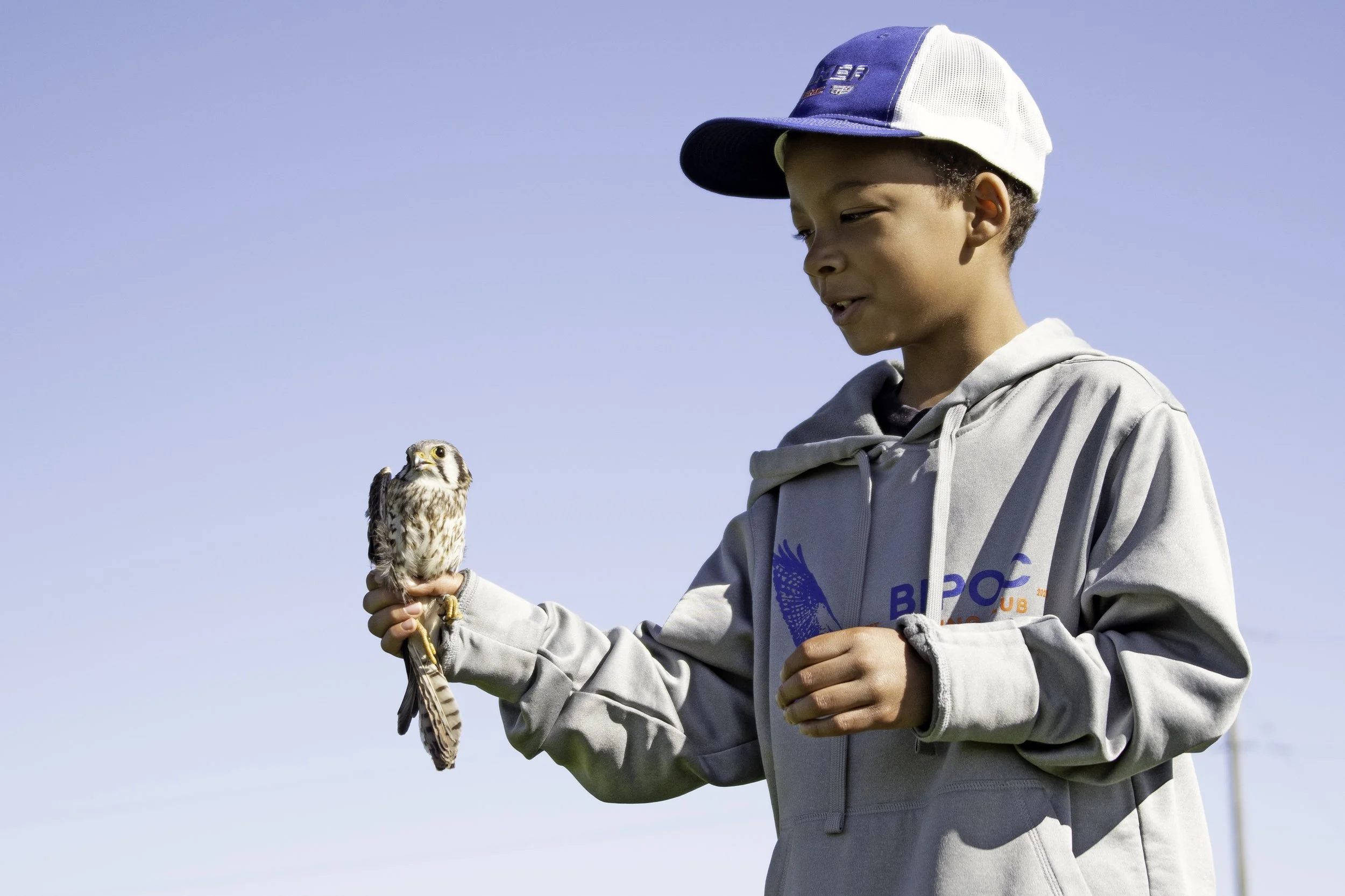
A young birder holds an American Kestrel after it was banded and got to release it so it could fly away (photo by Kaitlin Svabek/SoWBA staff)

American Kestrels are a small bird of prey. They're the smallest falcon in North America. And they're really fun fierce little birds. 

Mickenzee: They’re beautiful, yes. 

Brenna: Super pretty. They are in major decline like a lot of, they live in grasslands, so they like prairies and open spaces. So a lot of grassland birds are in decline. So fortunately with kestrels they really like nest boxes. They'll nest in them frequently. So we have volunteers that have a nest box assigned to them. Their job is to basically take care of the nest box and make it the best possible place for a kestrel to nest and then track if the kestrels are using it, if there are any eggs in it, if there are any chicks in it. And if there are, then the volunteers can go out and watch as a bander is able to put a band on the adults and the chicks.

Mickenzee: Woah!

Brenna: So to do this, we use what's called a spy cam. It's a tiny camera that we attach to a pole, because these nest boxes are pretty high up; they're like, you know, 12 feet up or something on a post. And so we put the camera in the nest box hole and it points down, so you can see on the other end of the camera line that whether there's a bird in there, if there are eggs in there and all that. And the other nice thing about using that spy cam is that it doesn't disturb the birds at all. So they can keep doing their thing, they barely even notice, and it doesn't bother them, it doesn't hurt them. And we're still able to collect data that way. 

Mickenzee: That's cool, you get to use some, like, real spy gear too. That's exciting.

Brenna: Right! So then moving into summer and fall, we do a lot of monarch tagging at a couple of our sanctuaries. This is where we catch Monarch Butterflies in a net and we place a tiny, basically weightless, sticker on a very specific part of their wing. And that sticker has a unique number on it. So we write down the number and the sex of the monarch, if it's a male or female and what plant it was nectarine on when we caught it. Collect all that data and then we release the monarch. And there are people in Mexico who are looking for these monarchs as they're doing their migration. And if they find a monarch that has one of those tags on it, they write all the same information down and that way we can see if any monarchs from Goose Pond Sanctuary in Arlington, Wisconsin migrated all the way to the Oyamel Fir trees in Mexico.

Mickenzee: Woah, what a journey. Do you get to know if your specific butterflies made it?

Brenna: Yeah, if your butterfly is found in Mexico, you get like, a notice and a certificate, yeah that your butterfly made it

Mickenzee: Oh, awesome! 

Brenna: So it's a really great program. It's really fun for families, really fun for basically anyone. Everyone turns into a kid when you have a butterfly net and you run through the prairie, it's just everyone's a kid it's so much fun. And then the last, actually two more, I'll mention Swift Night Out, which happens at the very beginning of the school year usually,when Chimney Swifts are migrating South. These birds are amazing. They are tiny, they almost never stop flying, they live almost their entire lives while flying. And they migrate from places like Wisconsin all the way to South America.

Mickenzee: Whoa! 

Brenna: Yeah, it's like 6000 miles round trip, so it's a huge migration. And to be able to save up enough energy, in the evenings they'll fly into a chimney and roost there for the night. But it's not just like one chimney swift in the fall, there are huge groups of them that fly into chimneys and stay there overnight. So sometimes it's hundreds, sometimes it's thousands. And so we have an event called Swift Night Out. Actually, these events are held nationwide in a lot of different places, but the one that we help with is based in Madison, and it's usually that first weekend of September. 

Mickenzee: It's so cool. I've seen it a couple times helping out at these events, and it's like a big tornado of birds funneling down into this tiny chimney. It is magical to see, it's so fun. 

Brenna: And as you're looking at that huge flock that's circling around the chimney, you're thinking like there's no way they're all gonna fit. And then pretty soon they just drop down in there and they cling to the walls on the inside. I don't know what it looks like on the inside.

Mickenzee: The biggest slumber party ever.

Brenna: Yeah, totally. Like, bring the popcorn, that sounds awesome! So that's a really fun one for people to bring, like picnic blankets and a snack and just hang out and, like, bring some friends. And it's often at Cherokee Heights Middle School, so there's a playground and a big field where people can run around and just have fun together.

Mickenzee: That's great.

Brenna: And then I'll mention one more, which is in Wintertime. This is called the Christmas Bird Count and it's the longest running bird community science program in the nation. And it's been going for over 125 years so basically we spend one day trying to document as many birds as we can. So people are like, okay, I'm going to go over to Ace Wood Park and I'll count all the birds I see there, and then there are other people who go to a different part of town, and other people who go all over the place. And then everybody puts their data together, and then we can say, we saw 94 species of birds in just this one day and there were, you know, 46,000 birds total that we counted. And we put that into a nationwide database. And it helps track changes of which bird species are there and not there, and in what numbers, year to year over, you know, 125 years. Yeah, so it’s a really fun program for beginning birders and expert birders and everyone in between. 

Mickenzee: Yeah, and oftentimes it's a group of people doing it together so it feels really nice to get out in the wintertime and celebrate birds together.

Brenna: Absolutely. It's great. 

Mickenzee: So I mean, it sounds like you've, like, covered just a wide variety of interests, whether you want to do something slow paced and just observations, more like social types of community science. It really covers the whole spectrum of what people might be looking for. And using spy gear, I feel that would be really a good pull for me.

Brenna: And those are just the ones that we do in our organization, not even all of them that our organization does. Like, there are others and there are so many more! There's a community science program on anything, one on bumblebees and one on water quality and one on light pollution, and whatever you're interested in there's a program that you could do relating to that. So, you know, if you can grab an adult and ask for help with like searching for a community science program that's relating to the thing that you are really passionate about, you will find something. And it's absolutely worth your time because it's so much fun and you learn so much. 

Mickenzee: Yes! Thank you so much, Brenna, for teaching us about these opportunities.

Brenna: Yeah. You're welcome, thank you.

-----

If you are interested in learning more about the community science projects SoWBA has to offer, please head to our website, swibirds.org, and go on over to the engage tab and click on Community Science. There you'll find not just the projects we have to offer, but other programs that get you out in nature too.

If you have a big nature question that you'd like to have answered, please have a teacher or grown up submit your question to info@swibirds.org with the title “Questions for QuACK”. Make sure to include your grade in the school you attend so I can give you a shout out. Thanks for tuning in and I hope you join us next time on QuACK!


Check out SoWBA’s free lessons, games, and activities!⁠

⁠Get out and explore nature with us! 

Make a donation to Southern Wisconsin Bird Alliance

Audio Editing by Mickenzee Okon

Transcription by Juanita Duarte

Logo design by Carolyn Byers and Kaitlin Svabek

Music: “The Forest and the Trees” by Kevin MacLeod

Ep 002: Bird Collisions with Brenna Marsicek (3-part episode!)

Brenna Marsicek holding a fluffy American Kestrel chick (photo by Mickenzee Okon/SoWBA).

In this multi-part episode, we talk all about the challenge that glass and other reflective surfaces pose to birds, and what groups like Bird Collision Corps (BCC) do to help with Brenna Marsicek, the Director of Outreach at Southern Wisconsin Bird Alliance.

Click the play buttons below to hear this episode or scroll past to see the transcription with some helpful images!

Subscribe to QuACK on Spotify, iHeart Radio, Apple Podcasts, or your favorite podcast app!

Transcription

Part One

Hey and welcome to Questions Asked by Curious Kids or ,QuACK, a podcast made by Southern Wisconsin Bird Alliance. This is a podcast where we gather questions about nature from kids to be answered with a local expert. My name is Mickenzee. I’m an educator and  I’m going to be the host for this series. This episode I’ll be interviewing Brenna Marsicek, the Director of Outreach here at Southern Wisconsin Bird Alliance, and she’s going to be talking about why birds hit windows and what we can do to help. This episode is pretty special because there are THREE parts. In this first part we’ll be talking all about citizen science and what the Bird Collision Corps does. In part two, we’ll talk and answer some questions submitted by kids and in part three we’ll talk about solutions that help birds see and avoid glass. Let’s jump in with Brenna!

-----

Mickenzee: All right. Hey, Brenna. Welcome on. 

Brenna: Thank you. It's good to be here. 

Mickenzee: Yeah. Okay, let's start off with, could you tell us a little bit about what you do? 

Brenna: Sure. So my official title is Director of Outreach. But I sort of consider myself the director of the fun stuff because a lot of what I do is planning events, and running programs, and working a lot with people who love birds, and engaging with people in ways that they can learn more about birds or help birds, or just deepen their experiences with nature. And so it's really, really fun. So I help plan our field trips and our adult education courses. I run the Bird Collision Corps program, as well as help support the Bald Eagle Nest Watch program. I help support our Kestrel Nest Box Monitoring Program, and I organize the Madison area Christmas Bird Count. And so basically, it's like whatever fun thing you want to do with birds, I get to somehow be part of it.

Mickenzee: Yeah, a little bit of everything. That's so great. This episode, we're answering big questions about bird collisions, and you mentioned Bird Collision Corps. Could you tell us a little bit about how you became an expert? 

Brenna: Yeah. So, you know, I know a fair amount about bird collisions, though I wouldn't consider myself an expert. And that's kind of, I think, how it should be. Right? Like we're always learning more. But when I first became involved with the bird collision issue, we were working with people on campus at the UW–Madison to start a study that looked at which buildings on campus were problematic for birds and hitting windows specifically. So at the time, you know, I wasn't really familiar with the bird collision issue. And I remember as a kid, the first time I observed this problem, I was getting my haircut and I was at my hair cutter's house and we were chit chatting. And I was probably ten years old or so, so like, you know, maybe a fifth grader and, you know, all of a sudden from the next room, we hear this huge crash and we rush into the room. There on the floor of her dining room was a Ring-necked Pheasant. 

Male Ring-necked Pheasant (photo by Arlene Koziol).

Mickenzee: Oh my goodness. 

Brenna: And surrounded by a shattered glass. And then we looked up at what used to be a window, which was no more, and then out at the beautifully landscaped backyard. And it was you know, as a rural setting. So there were pheasants and other types of wildlife, just like all over her yard, and so it wasn't hard to connect the dots of what happened there. That bird flew at the window and hit so hard it, you know, destroyed the window and died immediately. And I thought that that was a freak accident, that like me and just like a few other people in the world had experienced this. And then, you know, the 20 some years since then, I've learned that this is anything but rare, right? Like birds die after hitting windows a lot up to a billion birds every year. 

Mickenzee: Oh my goodness.

Brenna: So it's, you know, so this project came up where we wanted to study where birds are hitting windows on campus because there was conversation about how buildings are being constructed on campus and designed. And, you know, there are a lot of buildings that use a lot of glass now. And, you know, people were asking, is this a problem for birds? And we couldn't say for sure on campus whether it was a problem for birds. So we decided to start studying it and use, with the help of volunteers who go out and do these surveys every morning during spring and fall migration, so that we could learn which buildings are problematic. Why are they problematic? Can we fix any of those problem windows and save a lot of birds in the meanwhile? 

Mickenzee: Wow! I love how you have a personal connection. You have a big question and then you're working on how to answer it. 

Brenna: Yeah that's science right? Like that's how everybody gets into science I think is you have something that just like sparks that curiosity and then you just need to know more.

Mickenzee: Yeah.

Brenna: And in this case it's really, I think extra cool because you can have a really positive result from it. You know, it really positively impacts the bird population. If it's done right, you can do something about it and solve some problems. 

Mickenzee: That's so cool. Okay. So today all of our questions were submitted by third graders at Lincoln Elementary School here in Madison. And they were volunteers with the Bird Collision Corps. Could you walk us through what it looks like to be a volunteer with Bird Collision Corps? 

BCC survey kit (photo by Brenna Marsicek/SoWBA).

Brenna: Absolutely. So for our typical volunteer who's usually an adult, they, go on to our website and pick a spot where they want to do their surveys. So we have like a menu of options for buildings that people can survey. So they pick which one they want to survey and which day of the week they want to do it. And that day of the week for six weeks, they go out to their building, they walk around the outside of it and they're basically looking at the ground the whole time to see if they can find any birds that are on the ground underneath these windows, because that would be a sign that that bird hit the window and dropped to the ground right there. 

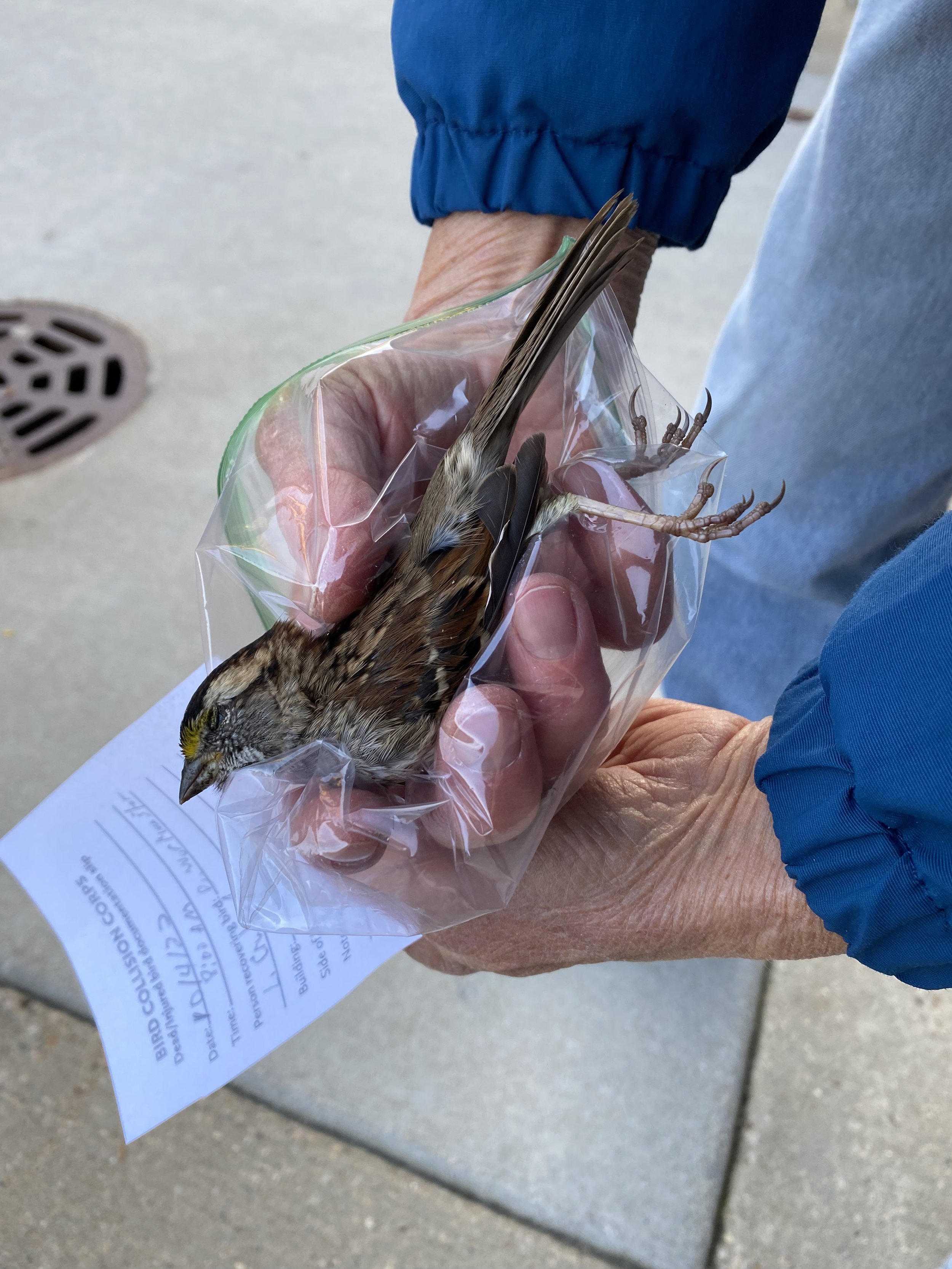
White-throated Sparrow being collected for BCC (photo by Brenna Marsicek/SoWBA).

So they have a survey kit. They've already done their training, so they're ready to go. They know what to do in their survey kit. They have the supplies that they need. So they have their observation form and they have baggies and slips and gloves and all sorts of things. So as they're walking around, if they see a bird that is dead, they fill out a form and they put it in the bag and they turn it into us so that we can examine it a little more. And then if they find a bird that's been injured, they put that bird into like a shoe box or a paper grocery bag, and they bring it to the Dane County Humane Society's Wildlife Center, where they will hopefully be able to help the bird get back to good physical health and then back into the wild. 

So after they've done this for, you know, six weeks in spring or fall, they will have submitted all of the data for their observations, you know, so every time they see a bird that has hit a window, they fill out their observation form. And at the end of the season, we collect everyone's observations and then we analyze it. So we look at how many and when and where, and we try to really fine tune where these problems exist so that we can help the building owners do something about it. And then we try to come up with a good list of recommendations for what that building owner can do to fix their window that would prevent birds from hitting it. 

So in the case of like the Lincoln Elementary students who did this, a group of students there each morning during their survey period when they were in school, students would walk around the outside of Lincoln Elementary and do the same exact thing. So they follow the same protocols that the adults do. 

They asked really good questions, and they noticed really good things about what was happening in nature in general, you know, so they would notice when there were certain birds coming back in and singing or calling, you know, and so they would notice, oh, the Blue Jays are calling a lot today. I wonder what's going on. And so they made really good nature observations while they were out looking for these bird collisions. So they did their walks around the building every morning. they didn't necessarily find a ton of birds, but we can talk a little bit more about that later if you want to. 

And that's a good thing. And so you know, having whatever amount of birds that, you know, the person finds at the building, that's an important number. Like that's what we want to know. We hope that they find none because that means that no birds died there. But if they do find some, then we can work on figuring out how to fix that problem area.

Mickenzee: Oh wow. That's great. 

-----

If you are interested in learning more about Bird Collisions Corps or getting involved  in other citizen science projects, please head to our website swibirds.org and go on over to the engage tab and click on citizen science. This is where you can find projects like Bird Collision Corps, and more of the projects that Brenna mentioned. Don’t forget to check out our events calendar to see what field trips and education opportunities are coming up. If you would like to learn more about birds and migration please head to the education tab and under free lessons and activities you will find games like migration obstacle course which highlight the struggles that birds face during migration.

And please please please be sure to come back to listen to part 2 and 3 to learn more about bird collisions and what we can do about it!

If you have a big nature question that you would like to have answered, please have a grown up or teacher submit your question to info@swibirds.org with the title “Questions for QuACK” Make sure to include your grade and school that you attend so I can give you a shout out! 

Thanks for tuning in and I hope you join us next time on QuACK!

Part Two

Hey and welcome to Questions Asked by Curious Kids, or QuACK, a podcast made by Southern Wisconsin Bird Alliance.This is a podcast where we gather questions about nature from kids to be answered with a local expert. My name is Mickenzee. I’m an educator, and  I’ll be the host for this series. This is part two to our bird collisions episode where we’ll be answering questions submitted by kids! If you haven’t listened to part 1, I recommend starting there, so you know all about how citizen scientists with the Bird Collision Corps collect data and learn about birds hitting windows. Ok let’s get started! 

-----

Mickenzee: Okay, so this student asks, why do birds chase their reflections in windows sometimes? And I bet a lot of people wonder the same thing.

Brenna:  Yeah, it's a very good question. And it seems really bizarre to us as people because when we look in a window and we see ourselves, you know, it's kind of goofy and we like, make faces at ourselves or wave or whatever, or just recognize that that's a reflection. But when a bird looks into a window and sees its reflection, it doesn't realize it's itself that it's seeing. 

So in spring, birds are setting up their nesting territory, and part of their job, especially the males, is to chase out any intruders that would be in their nesting territory. And so there are some species that are like even more likely to do this, you know, attack themselves in the window like cardinals and robins and even like sandhill cranes and turkeys do this a lot. They're really territorial. They make sure that there's no one in their area that could interfere with their nest. And so they're doing what they should be doing, which is protecting their nesting territory.

But the problem is, of course, that they're not actually defending the nest area against someone else. They're just attacking their reflection. So the way that we fix that is to try to eliminate that reflection that they see in the window. And so that's where a lot of these solutions come into play, is when we put something on the outside of the window that breaks up that reflection, and the bird recognizes that that's something that's not another bird or their reflection there. 

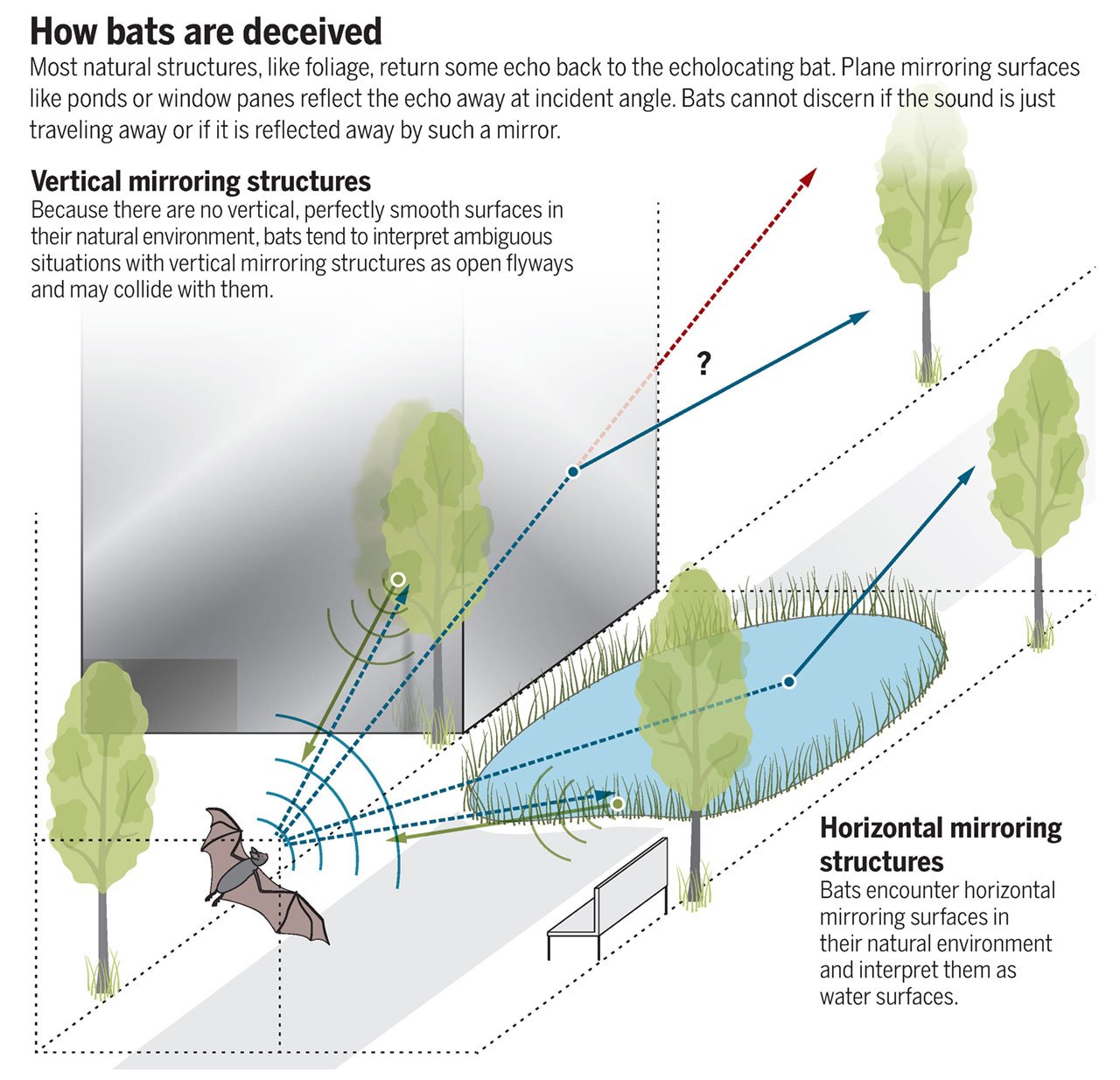
Mickenzee: Oh, gotcha. Yeah. All right. And so our next question is they learned that a bat hit the windows just like the birds do and they're wondering why would a bat hit the windows if they use echolocation?

Brenna: Oh, what a good question. 

Mickenzee: Yeah.

Graphic on how bats perceive glass. Credit: 
Stilz, Peter. "How glass fronts deceive bats." Science 357, 977-978 (2017). DOI: 10.1126/science.aao2989

Brenna: I love that. Someone was really thinking when they asked this question. So yes, bats do use echolocation when they're flying, which is a way for them to bounce noise or something that they can detect off of objects around them, so they know when there is something solid that they can't fly at, where it's clear space that they can fly through, and so on.

The problem with windows is that it's sort of like a mirror, where you have to be in just the right spot in front of it in order to see your reflection. And if you're kind of off to the side and you look in the mirror, you don't see your own reflection, it just bounces off and you see some other reflection of something else that's in the room.

So with a bat flying toward glass, if it's sending out its signal, if it's not directly in front of the window, the window will bounce that signal off, and it won't be able to receive the message back that there's something solid in front of it.

Mickenzee: That's so interesting.

Brenna: So then, yeah, then it ends up continuing to fly toward it because it doesn't perceive that there's something solid there.

So it's not very often that one of our volunteers will find a bat at the bottom of the window. It's happened maybe a handful of times since we started the program in 2018, but it definitely does happen. And it's very sad because just like birds, bats face a lot of problems as it is, and they do not need additional dangers like buildings to cause problems for them.

Mickenzee: Definitely. I learned something brand new today. Wow. Okay, so after all the data was collected for fall migration, the kids noticed something interesting. They noticed that two schools did not have many bird window collisions during fall migration, and they wonder if there are people around early in the morning that maybe scare the birds. And maybe that's why there's not as many birds flying into windows at the schools. What do you think of their hypothesis, Brenna? 

Brenna: That is a wonderful hypothesis. And I just wanted to start by saying that this is one of the best things about citizen science program. This is not citizen data collection. This is citizen science. So this is people asking questions and forming hypotheses. And they collect data and they get to see the data and they can, you know, determine if what they're wondering is correct or not.

I just love that this is a question in here that someone asked, because it means that they're really thinking about the data and what it means, and whether it matches up with their hypothesis. So good job to the third graders at Lincoln, the schools that were involved in our Bird Collision Corps Program. Yeah. They did not find many birds.

I think there were two at one of the schools and none at another. So that's a really good thought that there was something happening at the schools that might scare the birds away. However, I do think that a lot of birds would be active before there are kids and staff people at the school. you know, birds wake up really early to forage and move around, and usually people aren't even awake yet at that time.

So I don't know that we can say that that's the reason why we didn't find any collisions. And I know that these students worked really hard on their surveys, so I don't doubt that it's a survey problem. I think everybody did a great job with their surveys. My guess is that it has to do with the buildings themselves, because so much of the window collision problem happens because of how the windows at that particular place are reflecting, or are transparent enough that the bird wants to fly at it.

So it's very, very site specific. 

Mickenzee: Okay.

Brenna:  And, you know, if there is a really big flowering tree next to a window, a bird is more likely to fly at it. A lot of schools don't have a ton of landscaping like that right around the schools. You know, there tends to be trees that are set back a little bit in order for, you know, people to be able to see in and out of the windows and make the doors more open and playground areas more open.

So I think schools tend to have fewer collisions in general because of that. You know, landscaping tendency. 

Mickenzee: Oh yeah. 

Brenna: And there are some schools that I've been to that do have a lot of problems with collisions. So it's not an overall rule. It's just, you know, kind of a trend. So there was a school that was part of our Bird Collision Corps program in, I want to say 2019, a school in Middleton: Cromie Elementary.

And the students there found 12 birds, over the course of that year that had hit windows. So that's an example of a school that did find a lot. 

Mickenzee: Yeah. 

Brenna: Even though it's, you know, it's an elementary school just like Lincoln. it's just the setting is different. What the birds are seeing in the windows are different. And so the problem is different.

Mickenzee: And it's so cool that you have multiple different schools to look at. So you can narrow down, you know, different ideas about what you think might be happening. 

Highly reflective and disorienting windows (photo by Brenna Mariscek/SoWBA).

Brenna: Definitely. Yeah. It is really interesting. You know, you do a walk around the building and you look in the window to see what you can see in the reflection and sort of put on your bird lens in a way, you know, to see what a bird might see and why they would want to fly at the window. If they see a really tantalizing tree in the reflection, or if they see through one set of windows, and then on the other side of the room, there's another set of windows, and they think they can just fly straight through and be able to get out the other side. 

It is interesting to be able to walk around buildings and see what birds might see. You know, you kind of never see a building the same way again once you start using your bird lens, because then you are always noticing these places that would be problematic for birds. 

Mickenzee: Yeah. 

-----

If you are interested in learning more about Bird Collisions Corps, or getting involved  in other citizen science projects, please head to our website swibirds.org and go on over to the Engage tab and click on Citizen Science. This is where you can find projects like Bird Collision Corps, and more of the projects that Brenna mentioned in part 1! Don’t forget to check out our Events Calendar to see what field trips and education opportunities are coming up. If you would like to learn more about birds and migration please head to the Education tab and under Free Lessons and Activities you will find games like Migration Obstacle Course.

 And please please please be sure to come back and listen to part 3 to learn all about what we can do to help birds avoid glass. 

If you have a big nature question that you would like to have answered, please have a grown up or teacher submit your question to info@swibirds.org with the title “Questions for QuACK.” Make sure to include your grade and school that you attend so I can give you a shout out! 

Thanks for tuning in and I hope you join us next time on QuACK

Part Three

Hey and welcome to Questions Asked by Curious Kids or, QuACK, a podcast made by Southern Wisconsin Bird Alliance.This is a podcast where we gather questions about nature from kids to be answered with a local expert. My name is Mickenzee. I’m an educator and  I’ll be the host for this series. This is part three, and the final part, to our bird collisions episode where we’ll be talking all about solutions for birds hitting windows. If you haven’t listened to part one and two, I recommend starting there! Alrighty, here we go!

-----

Mickenzee: Okay. So finally we want to know what are ways that people can help birds to stop flying into windows? 

Brenna: Yeah. Great question I love the solutions question. So the main thing that we want to do to help birds from hitting windows is to reduce the reflection and reduce the transparency.

And so when you think about this, it's a window. Of course it's going to be transparent. And of course it's shiny, it's going to have a reflection. But there are things that we can do that still make the window a window for people that we can see out of and look into, but also more visible to birds. So that's the goal: Reduce the reflection and reduce the transparency, but still allow people to use them as windows. So there are a lot of different what's called a window treatment that you can put on the glass. So this might be stickers that you put on the outside of the glass or some kind of string that's put on the outside of the home or the building in front of the windows and it dangles down, or there are different types of paint that you can put on the glass.

Window collision tape (photo by Brenna Marsicek/SoWBA).

So there are tons of options, some of the most popular ones that we see and know people like in this part of Wisconsin is the dots that are they're really small. So they're like about the size of a pencil eraser. And you space them out two inches wide and two inches tall. And so you end up with like a grid with these dots on it.

The two inch rule is really important with this because there are organizations like American Bird Conservancy who has done research that shows that if the space is more than two inches apart, if something is like 4 or 5 inches away from something else, the birds will try and fly into that space in between. You know, the whatever's on the window, because they're really acrobatic and they're great fliers.

Window treated with window collision tape (photo by Brenna Marsicek/SoWBA).

So the spacing is important. It shouldn't be any more than two inches apart from each other. So these dots are they're really cool. They come on like a long tape and the tape is kind of sticky. And you put it on to the window and you really press it on the window, and you pull back the tape and just the stickers. The dots remain on the glass—

Mickenzee: Oh nice.

Brenna: —So it ends up looking really cool. And people can see the dots, but it's sort of like an insect screen where, you know, if you're looking at it, you can see it, but then your eyes really quickly learn to look past it. 

Mickenzee: Yeah. 

Brenna: And so you can still look out the window and enjoy the day, but the birds can see that there's something solid there. And it signals to them that that's not a tree that they can fly to. They have to go a different direction. 

Mickenzee: Yeah. Making the glass more visible for them. 

Zen curtains hung up in a window (photo by Susan Frikken).

Brenna: Exactly, yeah. There are other ways to do it. You know, you can make these curtains called zen curtains or Acopian BirdSavers.

And this is a material. It's a curtain that's made out of paracord, which is something they use in parachutes, which is why it's called paracord. So it's kind of like a slippery nylon string. And you basically just, like, make them dangle down in front of the window so that they kind of sway in the breeze and move around.

They can be spaced out a little bit further than two inches. So this one can be like 3 or 4 inches apart because they're moving and that kind of makes up for the spacing issues. So the birds will see these curtains on the outside of the glass and know that this is not something that they can fly towards. So there are lots of different solutions like that.

Some of them are really good for schools. Some of them are not good for schools, some are great for homes, but not for big buildings. And so you kind of just pick and choose what you like the style of and what you can afford and what you might keep up for the longest amount of time to be able to help birds the most.

Mickenzee: Yeah, definitely. Okay, so to recap, we learned about why glass is tricky for birds and bats too, and how we can use citizen science to answer our own big questions. And yeah, I learned so much today. Thank you to the third graders at Lincoln Elementary School for submitting your big questions. And thank you, Brenna, for coming to teach us.

Brenna: Of course. Thank you for having me and for all these great questions.

------

If you are interested in learning more about Bird Collisions Corps, or getting involved  in other citizen science projects, please head to our website swibirds.org and go on over to the Engage tab and click on Citizen Science. This is where you can find projects like Bird Collision Corps, and more of the projects that Brenna mentioned in part 1! Don’t forget to check out our Events Calendar to see what field trips and education opportunities are coming up. If you would like to learn more about birds and migration, please head to the Education tab and under Free Lessons and Activities you will find games like Migration Obstacle Course, which highlight the struggles that birds face during migration.

And if you have a big nature question that you would like to have answered, please have a grown up or teacher submit your question to info@swibirds.org with the title Questions for QuACK. Make sure to include your grade and school you attend so I can give you a shout out! 

Thanks for tuning in and I hope you join us next time on QuACK.


Check out SoWBA’s free lessons, games, and activities!⁠

⁠Get out and explore nature with us! 

Make a donation to Southern Wisconsin Bird Alliance

Audio Editing and Transcription by Mickenzee Okon

Logo design by Caroyn Byers and Kaitlin Svabek

Music: “The Forest and the Trees” by Kevin MacLeod

*All banding, marking, and sampling is conducted using established protocols under a federally authorized Bird Banding Permit from the USGS Bird Banding Laboratory.*