
Goose Pond Sanctuary Update: March 16, 2026
Southern Wisconsin Bird Alliance’s Goose Pond Sanctuary always has a ton going on. Bird conservation, habitat restoration, research, and outreach are always in season here. Learn more about Goose Pond through the update below, by visiting our Goose Pond webpage, or by exploring our Goose Pond StoryMap.
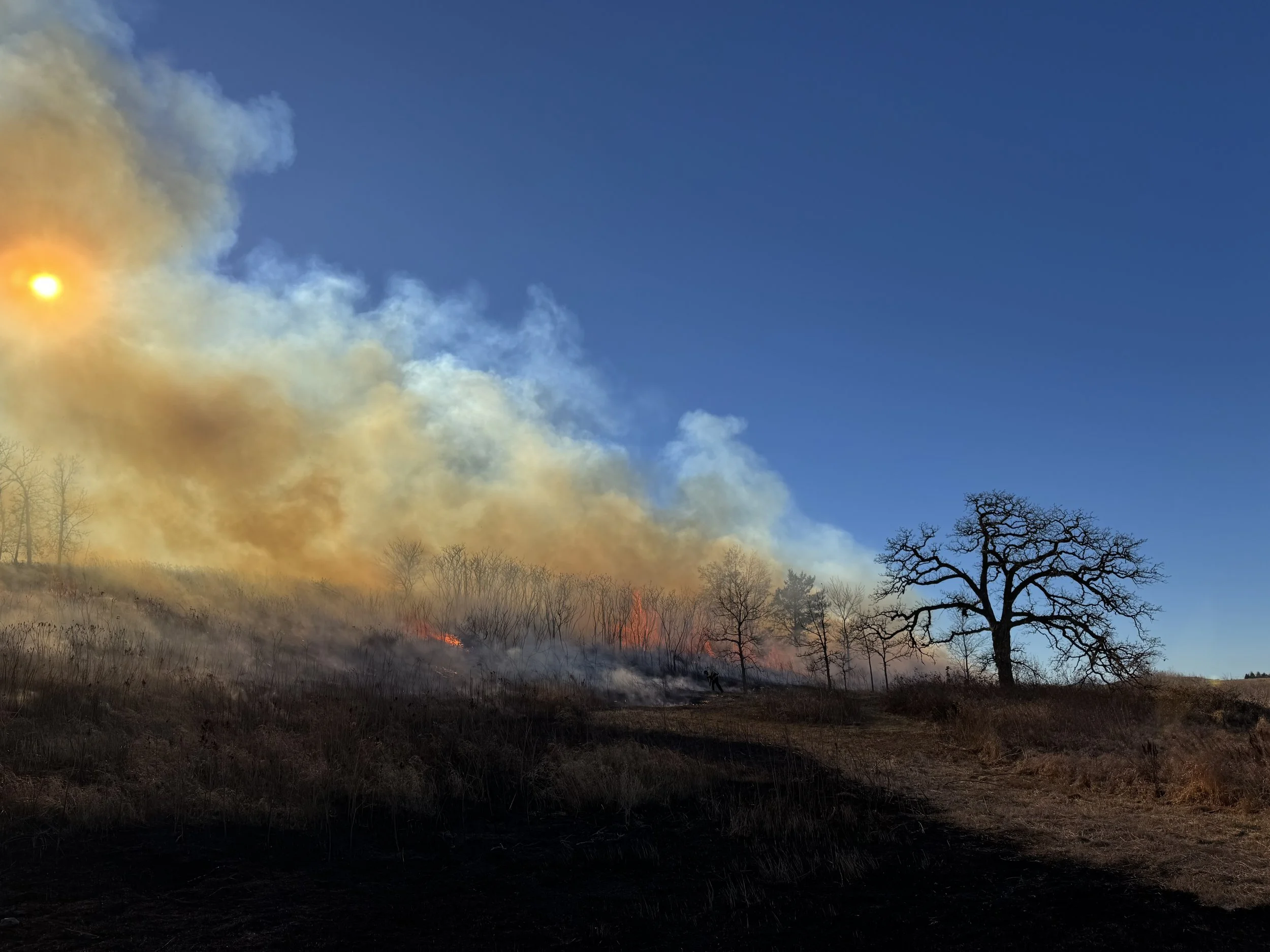
Cover photo by Emma Raasch/SoWBA. A prescribed burn is conducted on a hill at Goose Pond.
A Farewell to Goose Pond from Graham
Goose Pond staff, volunteers, and partners appreciate all the work that Graham has done! We look forward to touring with him when he returns to see what has happened while they were working and traveling in New Zealand. Read A Farewell to Goose Pond from Graham and Calla to hear about their time living and working at the sanctuary.
Seeds Collected, Cleaned, & Ready for Planting
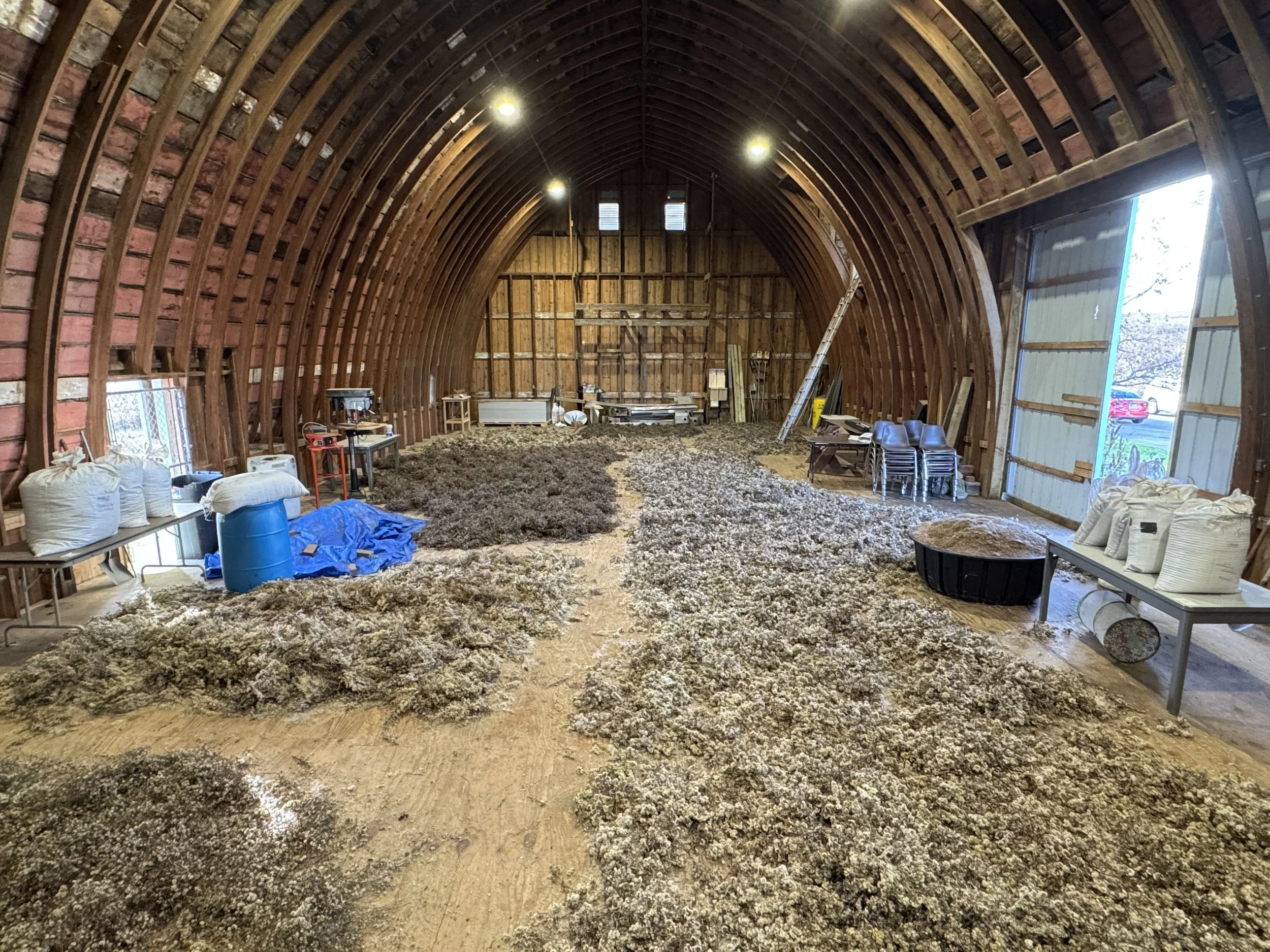
Seeds in the barn (photo by Emma Raasch/SoWBA).
We wrapped up the seed collection season at the beginning of November with a total of 125 species. A few notable numbers include 75 pounds of leadplant, 64 pounds of white baptisia, and 100 pounds of prairie dropseed. While it’s a critical part of prairie restoration, seed collection is also an excellent activity for volunteers, school groups, and of course, staff. We hosted twelve regular volunteer events and averaged 10 attendees. Also joining us this fall for seeds on special occasions were Poynette High School (25 students), Edgewood High School (26), and UW–Madison’s Biocore program (20). Most of the seed we collected went to Hillside Prairie Sanctuary and DNR wildlife plantings in Columbia County. But we also use some for interseeding at Goose Pond and on a variety of small projects in and around the Madison area.
Stiff gentian, a handsome and somewhat cryptic biennial, has been elusive in recent years, and usually we’d be lucky to collect an ounce. This year however, plants were EVERYWHERE. We collected about 10 pounds of clean seed totaling over 17 million seeds! We only collected from a small fraction of the plants that were found to conserve the seedbank. Was it temperatures last year? Something about recent droughts? We don’t know! If you have any theories, please feel free to reach out to Goose Pond staff. Thanks so much to our fall seed collectors—Logan Bahr, Cayla Matte, Sayre Vickers, Calla Norris, and Tucker Sanborn—and all of the volunteers who collected seed with us this year!
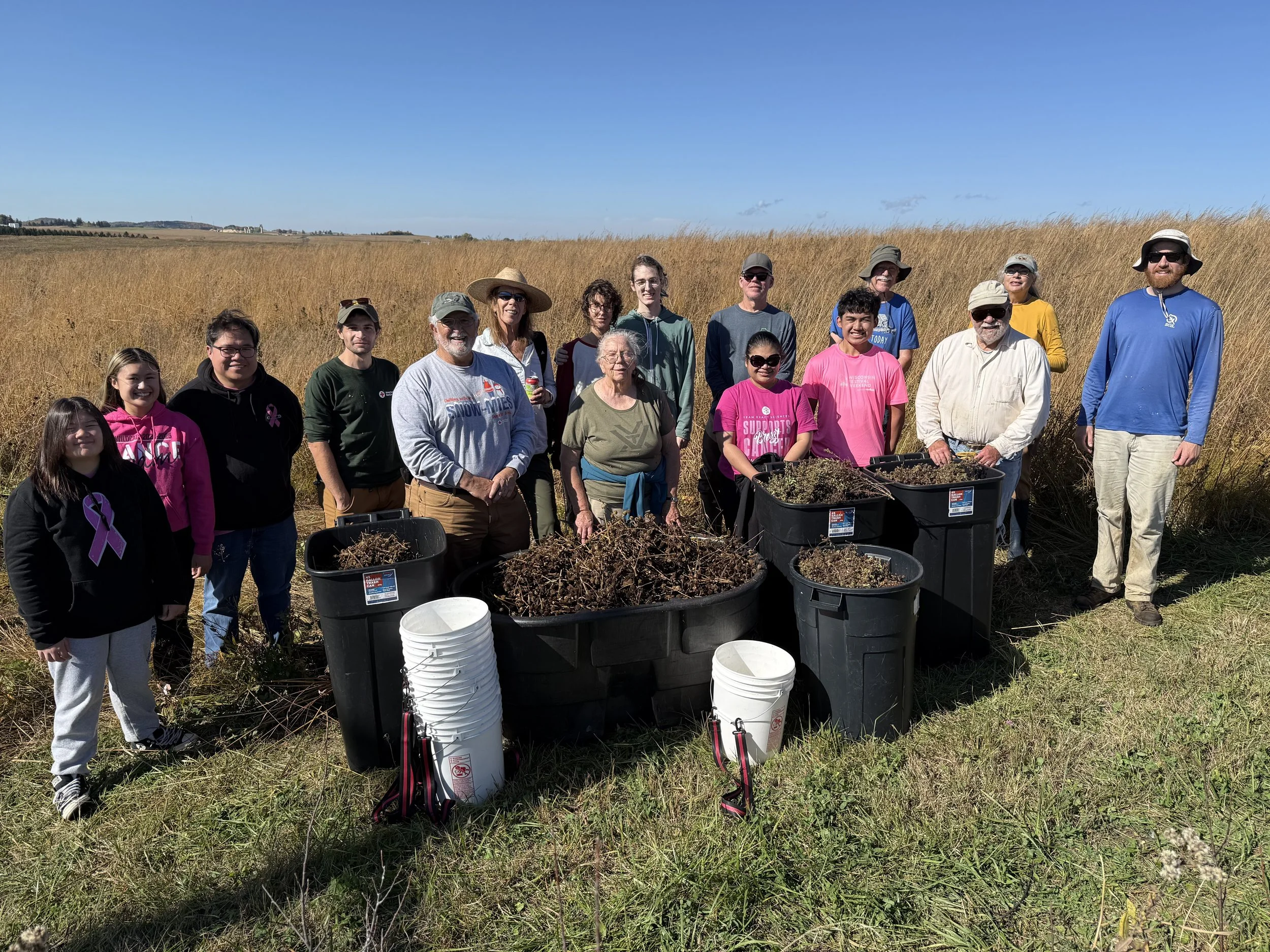
Seed collectors at Goose Pond (photo by Graham Steinhauer/SoWBA).
Brush Removal: Improving Savanna Habitat
Removing encroaching brush doesn’t happen overnight, but it can happen pretty fast with seven people working together. We’ve been taking advantage of having extra hands this late fall/early winter by tackling some long-time-coming projects:
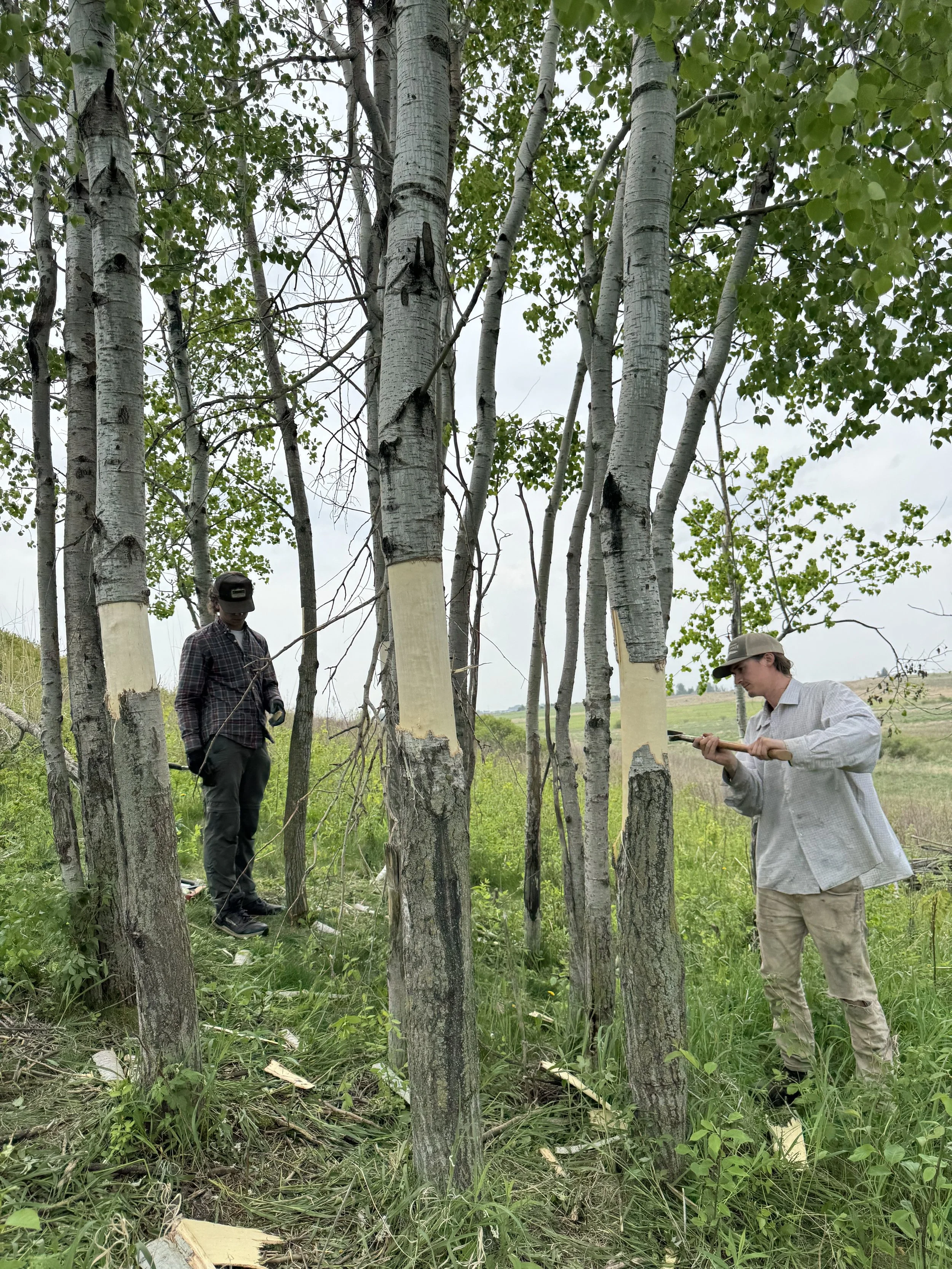
Graham and Andy Smith girding aspen (photo by Emma Raasch/SoWBA).
The north side of the hill at Goose Pond is especially susceptible to infringing brush and was dominated by sumac, honeysuckle, and aspen. We’ve been steadily chipping away at it for years, but it’s officially open and brush-free! Through the process we’ve uncovered a robust population of ninebark, a beautiful native shrub, and opened up the area around several medium sized bur oaks. Besides those, a clump of aspens remains, but fear not—they were girdled in May, and once dead, will be removed as well. We girdled them instead of cutting and treating since aspens are clone formers, and if you cut and treat the big ones, they will sprout numerous resprouts to take their place, which we wanted to avoid.
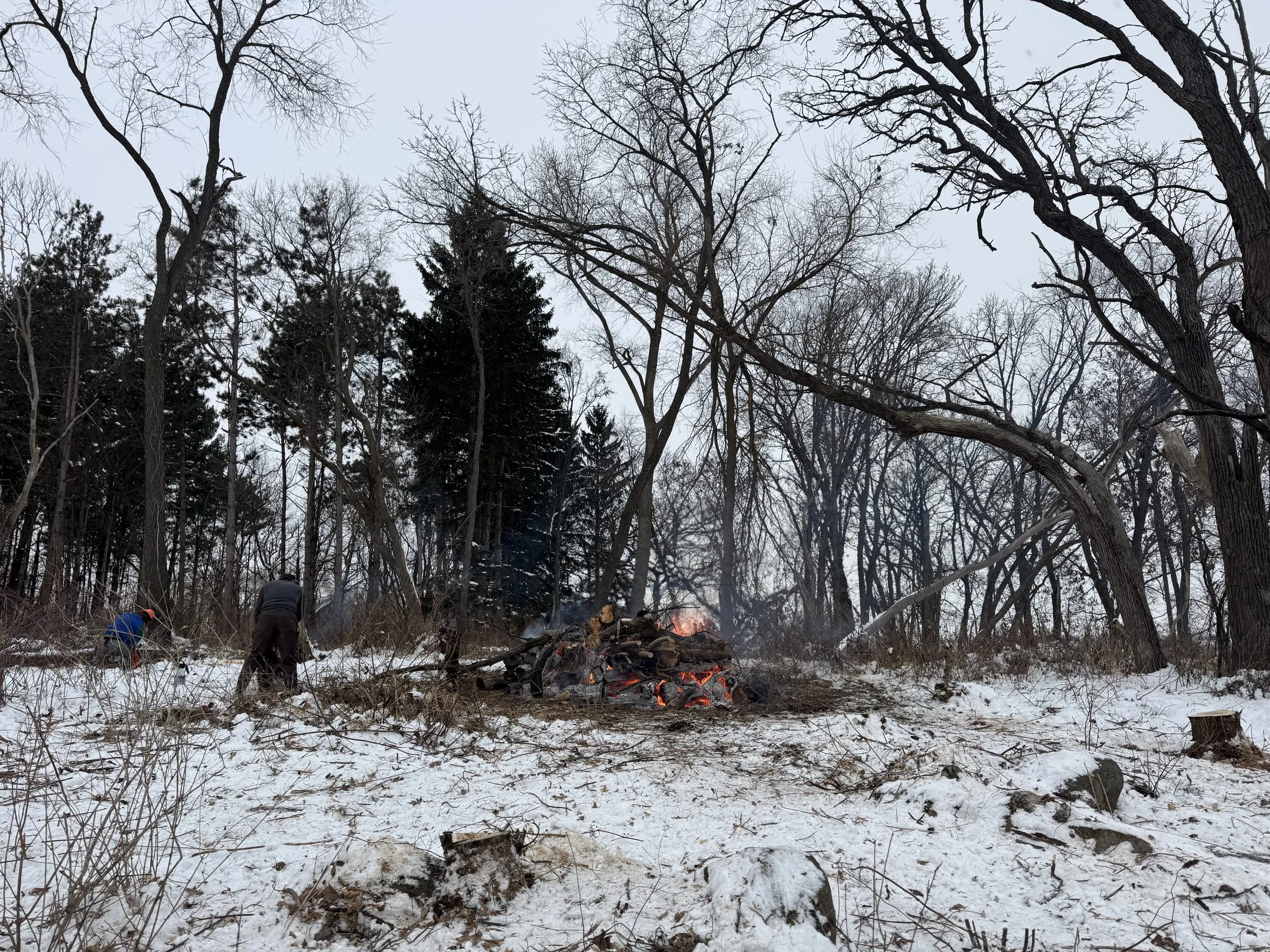
Brush removal at Otsego Marsh (photo by Emma Raasch/SoWBA).
We’ve also been spending significant time at Otsego Marsh removing boxelder and buckthorn on both sides of Old County Road F. The five-acre woodland in the northwest corner of the property has been a particularly challenging, but rewarding, effort. Similar to the hill, this progress took years, but we are starting to see the light at the end of the tunnel. The goal for this savanna restoration is to open up more space around the existing large oak trees and increase the diversity of native plants in the understory. After cutting and girdling large boxelders over time, the ground was unwalkable and made invasive species removal, burning, and interseeding nearly impossible. Just a few days of cutting, treating, and piling brush with our seasonal crew has made a monumental difference!
And of course, with any clearing, we make room for other things to fill the space—both good and bad. To combat the invasives that will fight for the new real estate, we interseeded the opened areas with diverse savanna seed mixes.
Fall Burning
Although we only had a short window for burning this fall, we accomplished some important units totaling 92.7 acres (46.7 at Goose Pond and 46 at Hillside Prairie Sanctuary). The weather was finicky and made planning difficult—special thanks to our volunteers’ patience and determination to get the burn in Browne Prairie done. . . the third (or fourth?) time was the charm! This unit will be spectacular in the summer and fall for admiring and collecting species like pale purple coneflower, white baptisia, and silphiums. We also burned the hill at Goose Pond. The north side of this unit is notoriously difficult to burn well, but this year was the best it’s ever burned.
Unlike the maintenance burns at Goose Pond that are intended to reduce brush, stimulate flowering plants, and increase plant productivity, the goal for the Hillside Prairie burns was to prepare the sites for planting. More specifically, our objective was to remove as much ground litter as possible to improve the seed-soil contact for planting this winter. Thanks so much to all our burn volunteers! We could not conduct these burns without you.
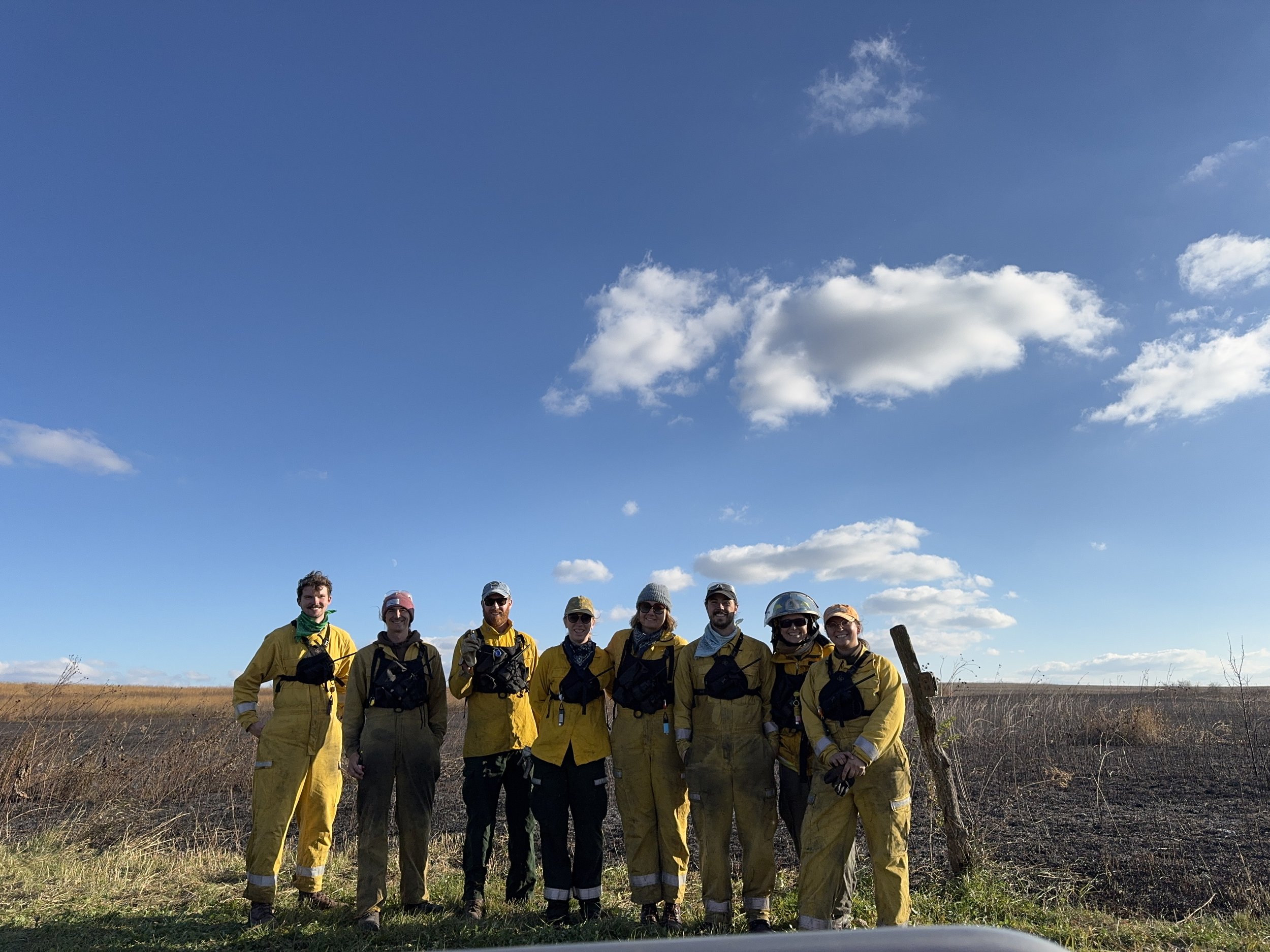
Burn crew (photo by).
Hillside Prairie Sanctuary Restoration Update
Much of the seed needed for the fall plantings is from the above segment on fall seed collecting. The Natural Resources Conservation Service (NRCS), Dane County Parks, and Bob and Gerry Benicoff provided funds to purchase seed that we could not collect. Some of the Benicoff funds were used to purchase one pound of meadow blazing star—the monarch’s favorite nectar plant. NRCS funds were also used to pay for site preparation and will be used to mow the new plantings this summer. Over 70 species were in the prairie seed mix.
Fourteen volunteers and staff hand planted 12 acres of prairie near the parking area on December 16. On January 29, Graham planted 34 acres south of the 12 acres in one day using a Dane County Parks Utility Terrain Vehicles (UTV) and a broadcast spreader. Before these plantings, there were 18.5 acres that were already planted. Thanks to the agencies, volunteers, and everyone that provided funding, loaned equipment, and helped with the prairie plantings.
Monarch Tagging and Field Trips
Our 2025 monarch tagging season was a huge success. We started tagging at Goose Pond on August 14 and tagged the last monarch on October 5. For the first time during a tagging season, we observed monarchs breeding, caterpillars feeding, and new monarchs emerging from chrysalises in late September and early October. Usually, most monarchs are completely gone by September 20, but peak migration wasn’t until that date or later in 2025. We tagged 1,499 monarchs (981 at Goose Pond, 139 at Hillside Prairie, and 379 by partners)—our second-best year ever! Though we host the same number of trips and have frequent volunteer efforts each fall, last year we only tagged 412 monarchs (261 at Goose Pond, 173 by partners). We were thrilled to see them in higher numbers this summer and fall!

Volunteer with monarch (photo by Arlene Koziol).
Thanks so much to the 134 field trip attendees and group leaders who guided them. We also appreciate the dedication of our partners, namely Curt and Arlys Caslavka (Pope Farm Conservancy), Janet Flynn and Greg Tiedt (longtime volunteers), JD Arnston (who tagged 37 monarchs on a single October day), and Jim Otto (our most prolific tagger overall).
We’re going to continue our monarch tagging program next year, but with an exciting addition. Scientists have developed a tiny solar-powered radio tag that tracks monarchs through their fall migration, and we hope to deploy around five tags that cost about $200 each.
The Prairie Lane Greenhouse
Rare Plants and a Little Piece of Tom Kemp
Dr. Tom Kemp, friend of Goose Pond and Graham personally, passed away in 2018. Though quite beautiful, Tom’s somewhat disheveled and maze-like house was set for demolition by the new owners, and Graham secured permission to remove items before the dumpster arrived. Graham saved rosemaled panels, the “sound horn” sign (well known to Tom’s visitors), and large sections of Tom’s greenhouse, which also acted as an aviary.
Many plant species are so abundant at Goose Pond that seed collectors find an effectively limitless supply in most years. On the other end of the spectrum, we’re lucky to get even a pinch of seeds from some very important, but hard to find, species. That’s where the greenhouse comes in.

Prairie plant plugs (photo by Graham Steinhauer/SoWBA).
Construction on the Prairie Lane greenhouse was completed in spring of 2023. While the lumber was purchased new, all other components (including the polycarbonate panels, windows, door, and insulation) were upcycled. Goose Pond staff use the greenhouse to grow rare or difficult-to-collect plant species like prairie bush clover (federally-threatened), purple milkweed (state-endangered), prairie violets, New Jersey tea, and prairie smoke from locally-collected seed. We produce about 450 plants annually, and plugs are either transplanted into our prairies or into garden beds for easy seed collection in the future.
While the greenhouse isn’t particularly useful in winter for plants, Graham is still in there a lot. Why? If it’s 20 degrees outside and sunny, you can expect the greenhouse to hover around a toasty 75 degrees. Tom would have loved that he could contribute to the greenhouse along with everything that goes on inside.
An update on Styx
the Whooping Crane featured in the September Update
Last summer Styx was at Goose Pond, paragliders were flying low over Goose Pond, flushing wildlife including Styx. Thanks to a bird watcher that filmed and reported the interaction between Styx and the paragliders, we then contacted Pete McCormick, the local Columbia County conservation warden. Pete’s investigation was written up in the Wisconsin Outdoor News, Cuffs & Collars page. “Warden Pete McCormick followed up on a complaint of persons paragliding over a wetland refuge near dusk and disturbing nesting birds which included waterfowl and a lone whooping crane. McCormick tracked down the responsible parties, who said that they were unaware of the impacts of their action, and had a good conversation regarding rights, regulations and the impacts to wildlife.” The paragliders did not return after that.
Articles, Opportunities, and More
Check out Goose Pond’s recent Friday Feathered Features: 2025 Poynette Christmas Bird Count (Feb. 27), Great Horned Owl (Feb. 6), Kinglets (Jan. 16), 2025 Songbird Nest Box Program Results for SoWBA's Columbia County lands (Dec. 5), Lapland Longspur (Nov. 7), Palm Warbler (Oct. 17), The Breeding Birds of Hillside Prairie Sanctuary (Sep. 19)
Check out Tom and Mary Lou Nicholas’ eNATURE REPORT 295, eNATURE REPORT 294, and eNATURE REPORT 293
Written by Mark Martin and Susan Foote-Martin, Goose Pond Sanctuary managers; Emma Raasch, Goose Pond land steward; Graham Steinhauer, outgoing Goose Pond land steward
